Showing posts with label gardening alternatives. Show all posts

Saturday, December 27, 2014

Chestnuts and Chestnuting in Washington DC 100 years ago when there were still a few Chestnuts

Chestnuts and Chestnuting.

The Sunday Evening Star. 27 December 1914. Washington, D.C.[1]

            The Rambler recently wrote of two famous chestnut trees— or the stumps of two famous chestnut trees— in the environs of Washington.  One of these was the chestnut tree in the home grounds of Conway Robinson,[2] called the Vineyard, under which [Senator] Daniel Webster and pious John Agg[3] of Rock Creek Church where want to indulge in toddies, and the other was the chestnut tree on the banks of the Anacostia river, beneath whose spreading branches John Howard Payne[4] and George W. Talbert of Chichester used to drink juleps.  These reflections in chestnut trees bring to Rambler's memory some very pleasant thoughts on the chestnut season now some weeks gone.  It is well understood that the lure of the chestnut is widely felt and has called many persons into the woods.  There is fascination which a large number of men and women cannot resist, or will not resist, not so much in the chestnut as in chestnuting.  They like to scratch among the fallen leaves for the rich, brown, velvet-smooth and fuzzy nuts, or pry them out of their spike-armed and satin-lined chambers, and one chestnut found is to these persons of greater value and sweeter flavor than half a pint bought at the corner stand. 

            On the walk which the great Washington family of wanderlusters made to the summit of Sugarloaf Mountain the Rambler noted an incident which illustrates what has gone before.  It was a long and dusty road from Dickerson {Montgomery County, Maryland] to the base of the mountain, and the "hikers," as they have come generally to be called, were strung out for a mile.  You're the base of the mountain, on its southerly side, is a crossroads with a store and house called Mount Ephraim.  A little beyond that point and off the left of the road, in a copse of chestnut trees, a young girl was hunting, and finding, chestnuts.  She was about 12 or 13 years old.  Her hair, in two bright blonde braids, was hanging down her back.  She carried her big straw hat under one arm and with her free hand rustled among the leaves on the ground.  Her big cat was brimful of chestnuts.

            The Rambler trying to say something about the fun of hunting chestnuts, and the young lady asked him to have some.  An invitation of that kind is not to be resisted and she gave him a handful, and then another, and proceeded to fill one of his coat pockets out of the bounteous store from the old straw hat.
            "What is your name?" The Rambler asked.
            "Oh! it is a hard name and you won't be able to say it," she said in very clear, clean–cut English, but with an accent not of this land.
            "German?" guessed the Rambler.    
            "No," said the little maid, with a trace of indignation in her tone.  "I am Dutch.  I was born in Amsterdam [The Netherlands].  My name is Henrica du Fries."

            That is, the name sounded very much like "Henrica du Fries."  Just then one of the Washington women came along.  She was tired and sunburnt and her tailored skirt with yellow with dust and her shirtwaist, which was so fresh that morning, was no longer fresh.

            "Little girl, may I have some chestnuts?"  she asked, and her tone indicated that she was prepared for a refusal.  But little Henrica came forward with a smile and that big straw hat full of chestnuts and was going to give the strange lady as many chestnuts as she wanted.  Then the strange lady said, in a voice that had grown 20 years younger in a minute:
            "Oh, little girl. I don't want to take your chestnuts, but if you will just let me come in there and help you to find some and find one for myself I will be so glad."

            The child laughed and the woman, laughed, gayly, and climbed through the old fence separating the dusty road from the chestnut trees, and was soon scratching among the leaves and giving out exultant little exclamations when she found the chestnut.

            The Rambler set up on the top rail of the fence, and with satisfaction cracked and choose the chestnuts which he had not found, and in course of half an hour he saw the incident of the woman and the chestnuts repeated, with sundry modifications, half a dozen times.  So he reasoned it out that it was not the chestnuts these men and women wanted, but the fund of finding them, and that they wanted to hunt for them because it brought back were freshened up some pleasant memories of their childhood days.

            A few days later the Rambler was passing over one of the [    ] and sequestered paths of Rock Creek Park, far away from the tracks used by those very ordinary mortals who ride in motor cars.  In the woods a few feet out the past a horse was tethered. He was hitched to a sapling by his bridle rein and the stirrups were thrown across the saddle.  Down among the dry, brown leaves stooped a grave and reverend seignior.  He is a federal judge and everybody who reads this would instantly recognize the name.  He had tied up his horse (which by the way, is a very free and clear footed jumper) and was groping in the leaves for chestnuts, and nibbling the sweetmeat with great satisfaction when he found one.   The Rambler tied up "Nancy" to a tree and fell to chestnuting with the judge. And as they scratched for the nuts the Rambler said:
            "Judge, you know Pat Joyce, the superintendent of this part, would have apoplexy and turn in a right call if he came on us poaching in these woods."[5]
            "Let him have apoplexy, but if you hear him coming we will make our escape," said the judge.  After getting a pocket full of chestnuts the judge and the Rambler moved on through the paths of the woods, and for several miles talked about chestnuts and horses.  Neither Congress nor the administration was mentioned once.

            Not long after this incident the Rambler was passing along that high part of the park on the backbone of land between Rock creek and Broad branch          , up near the jumping field. There are some chinquapin bushes and chestnut trees up there, but, of course, the chinquapins had been stolen several weeks before.  Squatting on the ground was a general in active service, perhaps the best-known general in the city, and who rides one of the best sorrel thoroughbreds that go over the brush hurdles, the bars and that turf–topped stone wall in Rock Creek Park.  His wife was sitting by him. They had a knotted handkerchief full of chestnuts which they had abstracted from this national preserve; and chicken sandwiches.  Their automobile, one of those large,closed-in affairs with a mechanician [sic] and a footman in livery, was standing by the roadside about 200 yards away. 
            "Have some chestnuts?"  Said the general.
            The Rambler told him that he had already stolen so many out of Pat Joyce's woods that he felt a little ashamed of himself, but that he would take a sandwich if there was one left.  And there was.
            "Chestnuting is great fun," said the general with the smiling approval of his wife.  "It's just like being children all over again."

            The blight[6] and the ax have destroyed thousands of chestnut trees throughout the eastern states, but the trees that survive or an extraordinarily large crop last season. It has been a great season for apples and chestnuts.  Europe supplied many tons of chestnuts to the United States each year, but the supply has been visibly diminished by the war and Americans are eating native chestnuts just as sweet but not so large as the European variety. The European chestnuts, Castanea sativa is variously called the "French" chestnut, the "Italian" chestnut and the "Spanish" chestnut.   In England they call it the "sweet chestnuts."   It is native to the mountain forests in the temperate regions of western Asia, Europe and North Africa and has been an important article of food with the people of those regions since recorded history began. With them it is not a tidbit to be merrily munched as with us, but a food of which meals are made. This chestnut is grown to some extent also in the United States. It was introduced into this country  by Irenie du Pont at Wilmington Del., in 1803,[7] and there is a record that the French chestnut was grafted on a native chestnut tree by Thomas Jefferson at Monticello in 1773. The native chestnut is formally known as Castanea Americana [Castanea dentata (Marshall) Borkh.], and in some American chestnut grows it has been improved by grafting from selected forms. There is another chestnut grown in the United States which was introduced from Japan into New York State in 1876.[8]   


[1] Transcribed by John Peter Thompson, 27 December 2014.

[2] "Conway Robinson, jurist, legal scholar, and historian. Having practiced law in Richmond, Robinson was a reporter in the Virginia court of appeals in 1842-1844. In 1846-1849, he took part in revision of the civil and criminal code of Virginia, and in 1852 he was elected to represent Richmond in the House of Delegates. In 1860 he moved to the Vineyard, his estate near Washington, D.C. He chaired the executive committee of the Virginia Historical Society. Conway Robinson was author of many works on law and history, including An Account of discoveries in the West until 1519 (1848), The Principles and practice of courts of justice in England and United States (1874) and History of the High Court of Chancery and other institutions of England (1882)". [accessed on 27 December 2014 from the website at:  http://socialarchive.iath.virginia.edu/ark:/99166/w6x3590v].

see also: Conway Robinson Author(s): John Selden; Source: The Virginia Law Register, Vol. 1, No. 9 (Jan., 1896), pp. 631-646; Published by: Virginia Law Review; Stable URL: http://www.jstor.org/stable/1098764 .

[3] George W. Riggs Jr. was 29 years old when he bought the farm of a bankrupt family friend,reporter John Agg, who had accumulated nearly $14,000 in debt and in March 1842, he petitioned for protection under a new federal bankruptcy law. Among his assets were a “Farm near Rock Creek Church containing about fifty acres” which had been known as “Wheat Yard Heights” and “Evesham Lodge.” [accessed 27 December 2014 at  William Degges, the man who built “Lincoln’s Cottage” November 2010. http://blog.historian4hire.net/2010/11/12/lincolns-cottage/]

[4]  John Howard Payne was born in East Hampton, Long Island, NY on June 9, 1791. n June of 1813, Payne went to England and was the first American actor to invade the British stage. A contemporary noted of Payne’s appearance: "Nature bestowed upon him a countenance of no common order, and though there was a roundness and fairness which but faintly express strong turbulent emotions or display the furious passions, these defects were supplied by an eye which glowed with animation and intelligence. A more extraordinary mixture of softness and intelligence were never associated in a human countenance, and his face was a true index of his heart."

While living in London and Paris, Payne began writing dramas. He also contributed to several operas, in particular, produced by Sir Henry Bishop entitled Clari, the Maid of Milan. This opera included the Payne’s composition “Home, Sweet Home”, written in 1822 and first sung in Covent Garden, England in 1823. After the popularity of the song spread throughout the world and Bishop claimed that in editing the song for Clari he created new music for Payne’s lyrics. This was recognized both popularly and officially and Payne never did receive royalties for his contribution to the song. [access from John Howard Payne. at the website: http://www.songwritershalloffame.org/exhibits/C201]

"Home, Sweet Home!" (1823) — A Victorian parlour song sung by Derek B. Scott: http://www.victorianweb.org/mt/parlorsongs/2.html
[5]  The park remained under the Board of Control until 1918, when Congress made it and its Piney Branch Parkway adjunct part of the park system of the District of Columbia. On September 16 of that year the park was transferred to the jurisdiction of the Office of Public Buildings and Grounds, which had managed the District park system since 1867. Its officer in charge, Col. Clarence S. Ridley, reported to the Army chief of engineers. [11] Grabill, attached to the office of the District engineer commissioner, was separated from the park, but his staff on the ground stayed. It was headed by Patrick Joyce, who had been appointed foreman in 1910, and then included three skilled laborers, a wagon boss, and nine unskilled hands. [An Administrative History-The Park Managers. accessed at http://www.nps.gov/rocr/historyculture/adhi2a.htm].

[6]  "Before the turn of the century, the eastern half of the United States was dominated by the American chestnut. Because it could grow rapidly and attain huge sizes, the tree was often the outstanding visual feature in both urban and rural landscapes. The wood was used wherever strength and rot-resistance was needed. In colonial America, chestnut was a preferred species for log cabins, especially the bottom rot-prone foundation logs. Later posts, poles, flooring, and railroad ties were all made from chestnut lumber. The edible nut was also a significant contributor to the rural economy. Hogs and cattle were often fattened for market by allowing them to forage in chestnut-dominated forests. Chestnut ripening coincided with the Thanksgiving-Christmas holiday season, and turn-of-the-century newspaper articles often showed train cars filled to overflowing with chestnuts rolling into major cities to be sold fresh or roasted. The American chestnut was truly a heritage tree.

All of this began to change at or slightly before the turn of the century with the introduction of Cryphonectria parasitica, the causal agent of chestnut blight. This disease reduced the American chestnut from its position as the dominant tree species in the eastern forest to little more than an early-succession-stage shrub." [Background on American chestnut and chestnut blight. accessed at http://www.esf.edu/chestnut/background.htm].

[7]  It would be neither safe nor advisable to attempt to give the exact date at which seedlings or nuts of the European chestnut or Spanish Chestnut as it was popularly called were first planted in American soil. Certain it is however that the introduction took place nearly a century ago and that imported trees have been bearing fruit in this country for over fifty years. It was in the region around Philadelphia Pa Wilmington Del and Trenton NJ that the first general introduction took place and from here has occurred the eventual dissemination of the different varieties to other arts of the country.

The initial introduction of foreign nuts was not as would be expected the work of horticulturists who wished to propagate them for economic purposes but the result of efforts made by wealthy individuals to secure rare and interesting trees adapted fo r planting on their new world estates. To the French "Marrons" is accorded the credit of being among the first to introduce the European chestnut. Irenee Dupont the founder of the now famous powder mills bearing his name was a recipient as early as 1802 of chestnut seed and young trees from France. Most of the seed failed to grow but records show that a few trees became established in his garden and flourished for years no doubt serving as a center of distribution for the surrounding country.
[accessed from .Ernest Albert Sterling. 1905. Chestnut culture in northeastern United States. J.B. Lyon co.]

[8] The blight fungus disease was first observed in the U.S. killing American chestnuts (Castanea dentata) in 1904. It has been widely accepted since that humans brought the disease to the US from Asia on imported chestnut trees. The first sighting of the fungus was at the Bronx Zoo, New York City. From there, the disease spread like fire throughout the eastern states, and across the entire natural range of the American chestnut. By the 1920s, the disease had even reached southern Ontario, and by the 1930s, the entire stock of American chestnuts was infected, with most of them dying. By 1940, over three and a half billion American chestnuts had been lost to the fungus. In less than four decades, a dominant American tree species had been converted to a threatened species.  [accessed from Chestnut Blight Fungus (Cryphonectria parasitica) http://www.columbia.edu/itc/cerc/danoff-burg/invasion_bio/inv_spp_summ/Cryphonectria_parasitica.htm]. 

Saturday, January 19, 2013

Invasive species 'boxbug' tries to sneak past APHIS

Gonocerus acuteangulatus (Goeze 1778)
boxbug
image from British Bugs web site


               Invasive species are all around us. The eat our lunch, they make us sick, and they change our landscapes. Invasive species cost us money...lots of money...some say over 130 billion dollars a year in the United States alone. Most of only get excited about invasive species when they directly and immediately injure us personally.  We remain landscape illiterate convinces that food comes from stores, and clean water from pipes.

               The United States Department of Agriculture's Animal and Plant Health Inspection Service (USDA APHIS) works to stave off the introduction and establishment of harmful invasive species.[1] APHIS and its ever-smaller budgets is faced with more "stuff' coming in to US ports each year. And who is APHIS' stakeholder that should be clamoring for increases to protect our pockets, food, and health? Why we the very people who have no clue. Somehow we have the idea that the infrastructure started by Lincoln and enhanced by Presidents through the 1960s now needs no support at all. Our arrogance is only unsurpassed by our inability to see tomorrow.

               If you live in the Mid-Atlantic you already know about the stink bug because it decided to not only cost the fruit industry millions but more importantly for you, because it moved in by the thousands to your personal space and caused you discomfort. So you call on APHIS and demand to know why and then fail to give it the money to prevent the next critter from moving in.

               With little support from the calmly disinterested public (those without stink bugs, pythons, flying fish and rock snot in their lives so far), the dedicated employees of APHIS and its sister organizations ARS and the Forest Service) work to keep the next invader out of your personal space. They work tirelessly to safeguard the United States much like the heroic 'Little Dutch boy' who stuck his finger in a hole in the dike to save his world from certain doom.

              And what has APHIS done lately for you - especially those of you who garden or make your living selling plants? In December, the keen eyes of USDA APHIS port inspectors in Baltimore, Maryland spotted for the first time a Coreid, Gonocerus acuteangulatus (Goeze 1778). G. acuteangulatus, commonly called known as a boxbug in the United Kingdom, id a "relatively large reddish-brown squashbug, distinguished from the commoner Coreus marginatus by the narrower abdomen and more pointed lateral extremities of the pronotum. Nymphs have a green abdomen." The website, British Bugs, goes on to describe this new invader to the US as historically very rare in the British Isles and known only from Box Hill in Surrey, where it feeds on box trees (boxwoods). British Buigs continues its report noting that the "bug is expanding its range and now occurs widely in the south-east of England and beyond. It is exploiting different foodplants, and has been found on hawthorn, buckthorn, yew and plum trees." Reports from England report that it seems prefers berry bearing species such as hollies and ivies.[2]  The boxbug is also reported as a major problem for hazelnut production in Italy.[3]

               APHIS also reports that the recently intercepted boxbug, G. acuteangulatust is a primary pest of boxwood, but is also recorded feeding on important landscape and garden plants such as hawthorn, buckthorn, yew and plum trees. According to a report in the Washington Times, the boxbug, referred to as a squashbug in the article, was "destined for Eldersburg, Md.  CBP (U.S. Customs and Border Protection) issued an Emergency Action Notification to the importer requiring the shipment to be re-exported or destroyed."[4]

               The possible introduction of this invasive pest would add to the litany of invasive species problems facing farmers and gardeners in the United States. We, all of us, should be actively supporting enhanced funding for USDA APHIS. It is worth noting that APHIS also quietly protects natural areas from invasive species that creep through our trade routes into our ports and out into our fields and woods.


[1] The Animal and Plant Health Inspection Service is a multi-faceted Agency with a broad mission area that includes protecting and promoting U.S. agricultural health, regulating genetically engineered organisms, administering the Animal Welfare Act and carrying out wildlife damage management activities.  These efforts support the overall mission of USDA, which is to protect and promote food, agriculture, natural resources and related issues.

To protect agricultural health, APHIS is on the job 24 hours a day, 7 days a week working to defend America’s animal and plant resources from agricultural pests and diseases.  For example, if the Mediterranean fruit fly and Asian longhorned beetle, two major agricultural pests, were left unchecked, they would result in several billions of dollars in production and marketing losses annually.  Similarly, if foot-and-mouth disease or highly pathogenic avian influenza were to become established in the United States, foreign trading partners could invoke trade restrictions and producers would suffer devastating losses.    http://www.aphis.usda.gov/about_aphis/
[3] Vaccino et al. 2008. Detection of damage due to bug feeding on hazelnut and wheat by biochemical techniques. Bulletin of Insectology 61 (1): 189-190.
[4] Jerry Seper. December 12, 2012. ‘Squashbug’ nabbed at Baltimore Harbor. The Washington Time. [accessed January 19, 2013] http://www.washingtontimes.com/news/2012/dec/12/squashbug-nabbed-baltimore-harbor/
"The importer plans to fumigate.
Upon Friday’s discovery of the bug, CBP forwarded the specimen to a USDA Animal and Plant Health Inspection Service Plant Protection and Quarantine entomologist for identification. CBP agriculture specialists work closely with USDA to protect the nation’s agriculture resources against the introduction of foreign plant pests and animal diseases.
CBP agriculture specialists have extensive training and experience in the biological sciences and agricultural inspection. On a typical day, they inspect tens of thousands of international air passengers, and air and sea cargoes nationally being imported to the United States and seize 4,291 prohibited meat, plant materials or animal products, including 470 insect pests."


Read more: http://www.washingtontimes.com/news/2012/dec/12/squashbug-nabbed-baltimore-harbor/#ixzz2IQluwQPK
Follow us: @washtimes on Twitter

Monday, April 23, 2012

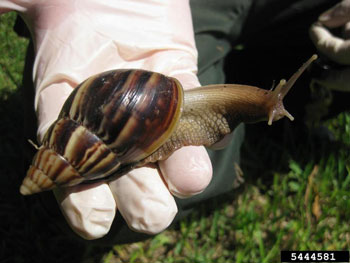
Have you met the Giant African Land Snail, an Invasive Species of the first order?


LISSACHATINA FULICA GIANT AFRICAN SNAIL, GIANT AFRICAN LAND SNAIL Texas Invasives.org http://www.texasinvasives.org/animal_database/detail.php?symbol=24 


              GAS (Giant African Snail, sometimes Giant African Land Snail) , (Lissachatina fulica, formerly Achatina fulica), is one of the most damaging snails in the world because it is known to consume at least 500 different plants including vegetables, fruits, and ornamental crops such as including beans, peas, cucumbers, carrots, onions, potatoes, spinach, broccoli, cabbage, and melons The invasive non indigenous (not native) snail is also the carrier of the rat lungworm, Angiostrongylus cantonensis.  As a invasive species goes this one rises to the level of charismatic in its own special way. The giant African snail, L. fulica, according to the CABI fact sheet, easily becomes attached to any means of transport or machinery at any developmental stage; is able to go into a state of aestivation in cooler conditions; and  is readily transportable over distances.  

            Florida is by virtue of its hospitable climates is under attack from a wide range of invasive species of which GAS is but one. The Florida Department of Agriculture and Consumer Services identified GAS in Miami-Dade County on Sep 15, 2011. Able to consume at least 500 different types of plants, the invasive snail "can cause structural damage to plaster and stucco, and can carry a parasitic nematode that can lead to meningitis in humans. Anyone who believes they may have seen a Giant African land snail or signs of its presence should call FDACS toll-free at 888-397-1517 to make arrangements to have the snail collected." (USDA NAL Invasive Species Information Center)

            The invasive GAS is a federally regulated species: Snails in the genus Achatina (e.g., Achatina fulica, the Giant African Snail), are specifically prohibited for both interstate movement and importation into the U.S. This snail species group is not only strictly prohibited from entering the U.S. but is safeguarded when discovered. (USDA, APHIS - Regulated Organism and Soil Permits: Snails and Slugs)

            USDA APHIS (Animal Plant Health Inspection Service) thinks that the giant African land snail, is originally from East Africa. The invasive snail has become established throughout the Indo-Pacific Basin, including the Hawaiian Islands according to APHIS. This mollusk has also been introduced to the Caribbean islands of Martinique and Guadeloupe. Recently, the snails were detected on Saint Lucia and Barbados. (USDA APHIS GAS Factsheet)

            USDA recently discovered and confiscated illegal invasive giant African land snails from commercial pet stores, schools and one private breeder in Wisconsin, Illinois, and Ohio. Additional finds of the snails have been discovered in Michigan. Amazingly, these snails are being used increasingly for science lessons in schools by teachers who are unaware of the risks associated with the snails and the illegality of possessing them.

The nematode (roundworm) Angiostrongylus cantonensis, the rat lungworm, is the most common cause of human eosinophilic meningitis.  In addition, Angiostrongylus (Parastrongylus) costaricensis is the causal agent of abdominal, or intestinal, angiostrongyliasis. http://www.dpd.cdc.gov/dpdx/html/angiostrongyliasis.htm   


                Giant African snails as mentioned above are carriers of the rat parasite, Angiostrongylus cantonensis. This parasite can be contracted by ingesting improperly cooked snail meat or by handling live snails and transferring snail mucus to the human mucus membranes such as those in the eyes, nose, and mouth. (Massachusetts Introduced Pests Outreach Project)

               If you have a Giant African Land Snail, PLEASE DO NOT RELEASE IT OUTSIDE OR GIVE IT AWAY.


 FOR INFORMATION AND ACTION
DA-2012-12 April 13, 2012

TO: STATE AND TERRITORY AGRICULTURAL REGULATORY OFFICIALS
The Animal and Plant Health Inspection Service (APHIS) is issuing a Federal Order, effective immediately, which establishes regulated areas in Miami-Dade County in Florida for the giant African snail (GAS).

On September 9, 2011, APHIS confirmed the detection of GAS, Lissachatina fulica, in a residential area of Miami, Florida. Since the initial detection, APHIS has actively worked with the Florida Department of Agriculture and Consumer Services to conduct survey, regulatory, control, and outreach activities. While residential areas have been affected, to date, extensive surveys of nurseries and agricultural productions facilities within the infested areas have been negative for GAS.
The attached Federal Order outlines the safeguarding measures required for the interstate movement of regulated articles from the areas regulated for GAS. The requirements in the State’s interior quarantine for GAS are parallel to this Federal Order.

GAS is one of the most damaging snails in the world because it is known to consume at least 500 different plants including vegetables, fruits, and ornamental crops.

For further information, you may contact Robert Balaam, Eastern Regional Program Manager, at (305) 278- 4872, or Andrea Simao, National Program Manager, at (301) 851-2067.
/s/ Osama El-Lissy for
Rebecca A. Bech
Deputy Administrator
Plant Protection and Quarantine
Attachment (1)
-Federal Order

Saturday, March 20, 2010

Invasive Plants & Butterfiles - A Collision of Desires

Spring has sprung in Washington and with it comes the fulfillment of the pent up urge to go out side and garden, to become one with nature, and to do good. On Twitter this morning (@InvasiveNotes) I found this tweet: @ionxchange: 75 Plants That Attract Butterflies Mistkitscom blog http://bit.ly/aS2f1i . This inherent goodness and wholesomeness of planting flowers and encouraging pollinators especially the ostentatious, non threatening butterflies compels attention and gives form to a garden plan of action. The dream of shirking clouds of summer iridescence draws us to lists of plants that are known to attract the butterfly.

If you truly want butterflies of course you need to provide them plants that help them more than just at the end of their lives. For before there is the wonder of the shimmering display of summer garden visitors there is the caterpillar eating its way through your garden securing a resting place mostly oblivious as it hide from your brood of song birds waiting for a meal. And worse perchance if you use chemicals, the caterpillar which can reduce a favorite spring plant to a stems and stalks is easily killed by wanton chemical applications. While butterflies are feeding off nectar and are not to particular as to the source, they are usually specialists in their fuzzy not so glorious to some caterpillar stage of life. In other words caterpillars tend to be specialists feeding on only one species of plant, not necessarily the one that you would plant for summer season flowering fireworks. And sometime the plant species with which they have evolved is one you also want to eat, thereby creating a collision of desires. Do you want the parsley, fennel and dill or the Black swallowtail, Papilio polyxenes asterius Stoll?

To me then falls the Grinch’s role of pointing our gingerly that there is a collision of desires lurking within the wonderfully created list. Invasive species, garden thugs that quickly climb the garden fence and escape into natural areas upsetting the native balance and sometimes displacing most of the native diversity prized in natural settings can be dangerous beauties. (Dangerous Beauty and other Invasive Species Traps Monday, May 25, 2009) In our fascination with homogenizing the world’s landscapes, we seek garden plants that will grow from Arizona to Maine and include Alaska and Hawaii too. Armed with this list we select those plants that are known to produce nectar in quantities readily available for the more flamboyant lepidopterans. We are not choosing plants for the caterpillars and in fact our one-size-fits-all lists have been written in part show-case plants that are not greatly affected by the endless hunger of caterpillars.

So in come waltzing the invasive species: butterfly bush, (non native) honeysuckles, privet, (non native) wisteria disguised because in deed they will supply nectar to butterflies even as they do not provide a food source for the caterpillars. Because invasive species are a global issue determined locally, what is invasive in your area o=is not necessarily invasive for some one in another part of the country. Many perennials like some species of daylilies, ground covers like English ivy, and beautiful shade trees like saw-tooth oaks may be invasive in certain situations and locations. I add the oak because all oaks are great food sources for 100s of different butterfly and moth species, but not all oaks are necessarily appropriate in your garden. Be careful what you wright; gardening is both a simple pleasure and a complex philosophy filled with dangerous beauty.

Friday, September 11, 2009

Landscapes, literacy, ecosystems services & sustainability

The way we approach our understanding of landscapes influences the policies we support and the attitudes we keep. How we “see” a flower, field or forest has consequences for how we “use” them. Our fragmented, parochial, limited time horizon, decision making matrix is a reflection of why our social systems are stressed. Our collective challenges, our great social causes, are all filtered through the fuzzy goal of immediate self interest versus long term social or public value. If a memory of childhood includes recollections English Ivy lined garden pathways, then there should be no denying this ornamental addition to the current garden desire. And more importantly, the cost of managing it in parks and natural areas should be born by someone else, or better just ignored. It is the immediacy of a strong interaction that attracts self interested actions, not the outcomes of weak interactions barely noticed in the present.

Ecological and environmental issues that swirl around ecosystems and biomes are hampered because of the growing lack of landscape literacy possessed by policy makers and their constituencies. Literacy is the ability to read, write, listen and comprehend, and speak a language. I think that there is an analogous set of abilities and skills that I call landscape literacy; the ability to read, work with knowledgeably, design, use and comprehend the intricate relationships of both natural and ornamental landscapes. Landscape literacy refers then to reading and working at a level adequate for communicating ideas about ecosystem services at a level that lets one understand the complex interactions of the system. These ideas at high level of literacy would include regulating, providing, provisioning and informing ecosystem services.

Most of the traditional problems and challenges of landscape management focus on the two higher level eco-system services, providing and informing. From aesthetics to resources that can provide material for personal and commercial use, our land use planning is concerned with enhancing an supporting these high level ecosystem services with understanding of the implications of additional stress onto the ecosystem in question. The assumption that natural resources are infinite permeates local land use and development policies in urban and suburban metropolitan areas. When we add the needs of those stakeholders who are either in economic challenged communities or historically under-served areas, we compound the problems of creating sound land use consensus. We have neither a common grammar for our ornamental landscape nor a well comprehended syntax for our natural areas.

The call for sustainable landscapes has been heard but not understood. Sustainable designs do not intentionally include invasive species, and may require some measure of certification that the flora and fauna is not itself a vector for invasive pathogens or insects. The idea that beauty may be more than color combinations and texture, is met with some resistance as is the reverse that there is a need for some order in landscapes that are functional in close proximity to human activities. Sustainability looks at the entirety of nature through asymmetrical temporal lenses communicating the past to the future through the present. (adapted from Crutchfield. 2009.http://www.physorg.com/news171800572.html) The collision of desires between our near-term aesthetic and economic sensibilities and the long-term requirements of the ecosystem and its ability to support out short term needs is in perpetual conflicted opposition.

Sunday, April 05, 2009

Invasive species beauty springs forth


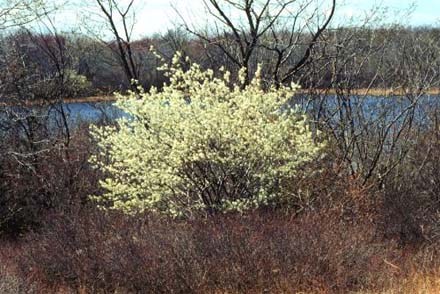
Springtime in the Mid Atlantic brings out the flowers and fragrances of blossoming trees and shrubs; and, if your knowledge of the landscape is high, the conundrum of the dangerous beauty of invasive species. Like roses in a corn field, purple loosestrife along streams and lionfish escaped from aquariums, the sweep of Callery pears (Pyrus calleryana), also know as Bradford pears, highlights the dichotomy between short term pleasure and long term cost throughout the woodlands of Maryland.

The seeming street and parking lot tree of choice is in full bloom competing with the Japanese cherries. The well-behaved cherries stay in place and are not seen in the woods and natural areas. The promiscuous pears produce hybrid off-spring that multiple unchecked on public and private lands creating a snow-like blanket of white along the roads and by-ways. The beauty is magnificent at a distance the smell up close is memorable; the damage to cars as limbs crash on roof tops is insurable.

Like the rose in the garden, the Bradford pear is beautiful in bloom, but is otherwise a weed competing for scarce resources and lowering the the harvest yield. Gardeners are very aware that some plants run amok and need to be controlled, removed and not planted near the garden. The Bradford pear damages the yield (services) of the ecosystem in to which is spreads. The non native tree creates biological deserts or monocultures reducing the amount of diversity. The homogenization of the landscape destroys the sense of place special to each location.


Another native worth considering in the landscape as an alternative to the ubiquitous pear is the green hawthorn (Crataegus viridis). Unlike the invasive pear, the hawthorn has four seasons of landscape ornamental interest from spring flowers, and summer foliage, to fall color and winter berries. The invasive Bradford pear hides its true destructive nature behind a fleeting spring display. As Vergil might have written: “Quidquid id est, timeo Prunos et dona ferentis

Sunday, February 15, 2009

Sustainability's Ecosystem Service Matrix

The concept of a tool for designing, creating, executing and maintaining a sustainable landscape involves the integration of several wicked problems among which, but not limited to, are climate change, invasive species, biodiversity, and social engineering. Because of the inherent complexities of nested hierarchies and issues of scale, discussions about sustainability begin with the classic challenge of wicked problems: “Every problem interacts with other problems and is therefore part of a set of interrelated problems, a system of problems…. such a system [is called] a mess (Ackoff).” The results of the system of systems, that is outcomes of a wicked problem, bring stakeholders together with preconceived solutions as the preliminary basis for their proposed definitions, classically blinding them to the definitional possibilities of other stakeholders. For example, a stakeholder approaching sustainability through the definitional matrix of climate change (regulating services) and its impacts will seek to weigh rules and outcomes heavily that favor carbon neutrality or negation. At the same meeting, while recognizing the importance of climate change’s impact on ecosystems, urban land development planners may tend to weigh transportation and housing factors (informing services) more heavily. At the same time, traditional gardeners and natural area managers will be focused on their turf war in the invasive species arena (provisioning versus providing services). Each of the four stakeholders will acknowledge the other’s concerns, but will be focused on issues which seem to directly impact their pre-definitional-outcome expectations which color the individual interpretations and expectations of the proceedings.

A broad consolidated definition of sustainability is offered by the School of Architecture at Washington State giving us: “Sustainable developments are those which fulfill present and future needs (WECD, 1987) while [only] using and not harming renewable resources and unique human-environmental systems of a site: [air], water, land, energy, and human ecology and/or those of other [off-site] sustainable systems (Rosenbaum 1993 and Vieria 1993).” The “future needs” in the consolidated definition of sustainability may be understood as the outputs of ecosystem services, where an ecosystem is defined as “… an area that contains organisms (e.g., plants, animals, bacteria) interacting with one another and their non-living environment. Ecosystems can be of any size (e.g., forest, meadow, and log).”

At work in the discussion are two assumptions, one completely wrong which assumes natural resources to be infinite, and the other which at a high level presumes linear solutions for non-linear problems. The first function , a type of group integration of resource expectations, is the foundation for the at best absent stakeholders who see not need for a sustainable solution because their operation model predicts no longer problem; their absence is a major stumbling block because wicked problems require all stakeholder to be equally right and at the table. The second problematic function looks towards a linear solution model of the type: first do this then to that and a goal will be met. Ban all non natives is a linear solution to a wicked problem’s non linear complexities.

Bearing in mind the two problematic models, we begin to assemble a list of services provided by an ecosystem. The services can be arranged in four nest hierarchies. The foundation is the regulating and supporting services which provide the mechanism for the next group which are the provisioning and preserving services, followed by providing and then informing services . The actual individual services can be expressed either by Constanza et al or deGroot et al but either way need some a priori agreement.

This system is based on an anthropomorphic view point which drives the two part dynamics of the matrix and serves to further confuse initial conversations. The first two services regulating/supporting and provisioning/preserving function with or without Home sapiens. At the same time human activity can wreak havoc on the function of these two levels of ecosystem services. In other words, while we are not necessary to the workings of the services therein, we are fully dependent, and fully engaged, and completely able to become a very large determinant variable with in the system altering the system’s ability to sustain itself in historic and predictable ways. Our human technological abilities give rise to the providing services whereby we manipulate the ecosystem for resources such as food, fuel, fiber, feed, flowers, and forest. At this point human cultural needs are expressed by the informing services completing the four part system.

The next consideration is related to the problem of scale. Regulating/supporting services operate at micro scale levels with macro scale effects. The regulation of atmospheric gases is on a molecular and cellular levels (small/fast operations) which when taken together over time have a large/slow effect on climate. The aggregation of many small/fast operations over a non delimited area accounts for the impact of the services at this end of the continuum. Intuitively attempting to establish a metric for these aggregated services by delimiting artificial boundaries seems inadequate. The scale is one of micro to macro and may be thought of as without bound or limit; that is unconstrained by human artifice.

The scale reverses as we move up the system to the informing system which fits very nicely with in human constructs and is defined at least in bard by boundaries which give context to the informing nature of the ecosystem services. We rather expect a delimitation of the soccer field garden or sacred space. Here the efforts of human endeavor attempt to reduce the fast small and slow large functions to human time scale, and in doing so reduce the immediate effects to an artificial boundary with the reverse functionality of the regulating services. That is we have one operation/operator at a time on many distinct bounded areas. And thus we use macro operations which have micro effects such as planting an alien exotic species which is a macro event with micro effects.

To this we now bring the economic valuation component expressed in terms of public value. This matrix places the regulating and provision services within the realm of public goods and the providing and informing within the realm of private goods, and demonstrates the natural fault lines of initial sustainable conversations. The tension between large interests groups splits in the expected private property, market preference versus common good and public value. In addition, the artifices of boundaries overlay neatly with the implications of the matrix.


ECOSYSTEM SERVICE

AREA

EXCLUDABLERIVALROUS
regulatingnaturalunboundednon excludablenon rivalrous
provisioningnaturalunboundednon excludablerivalrous
providingartificialboundedexcludablerivalrous
informingculturalboundedexcludablenon rivalrous

Sunday, February 08, 2009

Sustainable Sites Symposium (NAED), Feb 2009, Austin Texas

John Peter Thompson will participate as a member of the technical team's sub committee on vegetation
University of Texas at Austin:
Sustainable Sites Symposium
February 13/14 2009

This symposium will focus on presenting, evaluating, and connecting the various sectors of research and applied knowledge available for developing, maintaining, and monitoring sustainable sites.
Participants will present existing research and look at gaps or limitations in the knowledge base to support efforts to measure and promote sustainable sites.
The Symposium will focus on five research areas that support the Sustainable Sites Initiative: soils, water, vegetation, materials, and human health.
Panels of experts will (1) present Sustainable Sites Initiative findings and metrics developed from these findings to date, and (2) present case studies from projects related to each of the five topic areas.
Participants will discuss findings and their applications as a group, looking for connections and disjunctions that can be shared broadly and that form the basis for future research.
The National Academy of Environmental Design (NAED) represents more than 500,000 members.
People involved in NAED activities come from both industry and academia and are among the world’s most knowledgeable in their field.
The NAED membership provides the leadership and expertise required to accomplish complex research projects on issues such as climate change, resource depletion, and energy security.
The existing National Academies arose during times of extreme need for the nation—the Civil War, the Space Race—and the NAED is developing in similar fashion.

Friday, February 06, 2009

Sustainability in the Landscape & Invasive Species

Why are invasive species so bad? One answer is that they negatively impact ecosystems; they bring an imbalance which at the very least causes stress and may under extreme conditions begin to destroy integral relationships and interaction necessary to a functioning ecosystem. The introduction of kudzu or Lythrum may result in a monoculture or biological desert. The complex web of food chains between trophies levels is eliminated and the system simplified. The ecosystem resources ability to provide services are correspondingly reduced to, for example, a possible regulating service such as erosion control on the part of kudzu or an informing service (aesthetics) on the part of Lythrum . The complex web of weak ecological interactions is reduced.

Sustainability in a certain sense is the process of maintaining the homeostatic relationships of an ecosystem. Invasive species reduce the efficiency of an ecosystem by replacing a web of weak interactions with a few strong interactions. Invasive species interfere with the feedback mechanism of an ecological system. An addition of a top predator such as mute swans, feral swine or cats can quickly bring an imbalance to the system. The feedback mechanisms which would normally tend the system towards equilibrium no longer function and the system begins to fragment.

The premise that this is a bad thing, the imbalance and degradation of the ecosystem is based upon an assumption that the ecosystem services as a resource have a value and a cost. A person who assumes that the resources are infinitely available would take strong issue with the idea that his or her use of these services should be restricted or should cost. The introduction of an invasive species, therefore, is an extranality to which the person is entitled by right. This sets up the dichotomy between market preference and public value. Our economic system and assumptions is based upon this infinite resource premise; it is hard to borrow money if you own a bog without a plan to drain it and pave it. A bog has “no” value for it generates no measurable return (ecotourism aside).

This in a world of infinite ecosystem services (regulating, provisioning, and providing) which are considered free, the introduction of Hedera helix, English ivy, in Maryland is not a problem but rather a solution to a short term landscape need accordingly a use of a high level ecosystem service, that of informing. The possible negative impacts to lower level ecosystem services are not easily measurable in a market preference sense and thus are not taken into consideration.
A sustainable landscape would “value” the complete palette of services attempting to support complex interactions and relationships. At the very least it would try to do no harm. So we wobble between our values system and our market choices a dynamic political tension with no linear solutions and great probability of unintended consequences no matter which side we take. Do nothing is not an option.

Thursday, February 05, 2009

Sustainable Landscapes - Invasive Species

When invasive species are removed from the garden, our landscapes are on their way to being sustainable. As on of the volunteer members of the technical sub committees working on the Sustainable Sites Initiative, I have had the privilege to learn and contribute to a comprehensive design paradigm which addresses sustainability in the landscape. An article in the Washington Post begins the marketing of the sustainable garden idea. The idea of invasive species in the garden can be unsettling, and has in the past created animosity between those who would protect natural areas and those who would enhance ornamental areas.

At the heart of the Sustainable Site program lie ecosystem services. The ecosystem provides humanity with functions mostly taken for granted and assumed to be free. Services and processes such as moderation of weather extremes, dispersal of seeds, mitigation of drought and flood, protection of living organisms from the sun’s harmful ultraviolet rays, regulation and movement of nutrients, protection of stream and river channels as well as protection from erosion along coast lines, detoxification and decomposition of wastes, control of agricultural (food, feed, fiber, fuel, flowers, forest) pests, maintenance of biodiversity, generation and preservation of soils and renewal of their fertility, contribution to climate stability, purification of the air and waste, regulation of disease carrying organisms, pollination of crops and natural vegetation, creation and support of recreational activities.

Sustainable landscapes mitigate the negative effects of invasive species to ecosystem services. Sustainable landscapes are about much more than just invasive species, of course, but since invasives from pathogens to animals, including some favorite garden plants negatively impact ecosystem services, choosing a sustainable alternative makes sense.

Tuesday, November 04, 2008

Sustainable Landscape Alternatives: www.sustainablesites.org

The Sustainable Sites Initiative proposes an alternative to traditional landscape design principles offering a tool for those who wish to garden, want to limit invasive species' impact, and enhance environmental services. As a member of the technical sub committee on vegetation for this project , I am excited to be part of a new vision for landscaping, as a long time grower and retailer of garden plants and garden solutions, I am delighted to offer my customers a choice.

Sustainable Sites Initiative - http://www.sustainablesites.org/

The Sustainable Sites Initiative is an interdisciplinary partnership led by the American Society of Landscape Architects, the Lady Bird Johnson Wildflower Center, the United States Botanic Garden and a diverse group of stakeholder organizations working together to foster a transformation in land development and management practices. Through the creation and implementation of clear and rigorous design, construction, operations, and maintenance criteria, the Initiative aims to supplement existing green building and landscape guidelines as well as to become a stand-alone tool for site sustainability. The U.S. Green Building Council, a major stakeholder in the Initiative, anticipates incorporating the benchmarks into future versions of the LEED® (Leadership in Energy and Environmental Design) Green Building Rating SystemTM.

The Initiative envisions that sustainable land practices will enable natural and built systems to work together to protect and enhance the ability of landscapes to provide services such as climate regulation, clean air and water, and improved quality of life.

Guidelines and Performance Benchmarks Draft 2008Available on November 10thOn November 10th, the Sustainable Sites Initiative will release the Guidelines and Performance Benchmarks Draft 2008 for public comment. This important milestone builds on the initial Standards and Guidelines: Preliminary Report released in November of last year. The new draft will contain over 50 proposed prerequisites and credits ranging from site selection to sustainable maintenance practices. The metrics’ format will be similar to existing LEED tools in structure and will include the following components:

Credit intent
Ecosystem services addressed
Social and economic benefits
Requirements
Submittal documentation
Technologies and strategies
Resources


The Guidelines and Performance Benchmarks Draft 2008 will be available for download and public comment beginning on November 10, 2008 at www.sustainablesites.org/report. The public comment period will close January 20, 2009. Public review and comment is essential to the successful development of these guidelines and performance-based benchmarks. To participate in the review process, visit www.sustainablesites.org/review.Case Study Library OnlineThe Sustainable Sites Initiative received over 125 submittals to the call for case studies. These case studies demonstrate a wide variety of sustainable practices addressing issues associated with stormwater management, integrated design process, habitat restoration, material management and other sustainable practices. The Initiative will continue to build this library over time from the wealth of innovative submissions we have received. We appreciate the willingness of these organizations to share their experiences through the case study process. Future opportunities to submit additional case studies will be promoted on the website.


Sunday, September 28, 2008

Invasive Species: Selling on the Front Lines

Sunday, I took to the sales floor of the garden center to help with sales. Within five minutes of getting there, invasive species opportunities arose in force. As I was helping a customer select a few native plants for her shade garden, I saw and heard a gentleman running after the nursery’s IPM consultant shouting, “Wait! I need to get information on an invasive plant for the shade. Wait!”

Of course the consultant moved on and my wife directed the anxious customer in my direction, pointing out with the approval of the consultant that I was the invasive guy. “I need an invasive plant for my shade garden,” the customer said.

Customer service dictates that rule number one should come into play. Rule number one in retail: The customer is always right. Rule number two: If the customer is wrong, see rule number one.

I now had the delicate job of explaining that he had just approached the National Invasive Species Council Advisory Committee's acting vice chair, and that perhaps there was some information that I could share before we went too far in the actual selection of an invasive species for his garden. I pointed out that on the continuum of bad choices, we could offer to sell him natural area (Maryland) public enemy number one, English ivy, or perhaps just slightly less problematic, periwinkle, and if I had talked him out of those two, Japanese spurge might seal the deal and my doom. Fortunately, he had decided for personal reasons of style and taste that pachysandra was out, and that he had enough vines already.

With further conversation, I was able to introduce him to Christmas fern, and then frantically began to look for Asarum canadensis, only to find that we did not have any in stock. The entire dialogue left me thinking how much work there is to be done at the retail level. We need to provide information in a fashion that allows our customers to make informed choices. Trying to be positive about a negative when someone is trying to give you his money is a touchy, dicey proposition.

Having recovered from this first engagement on the sales floor, I moved to our euphemistically named “chemical” room. I have tried without success to get our staff to call this something else, anything else for years, but after 80 years in business I am stuck with a name appropriate to the 1950’s. A continuous stream of radio traffic from staff includes the phrase :chemical” room while drecting customers to our organic choice area. The irony is apparent only to me So, I thought I would go see what our customers were doing.

Of course, when a customer sees a bug, those who choose the “chemical” room want the maximum toxicity. They usually are not in quibbling mode, so working this part of the business takes a certain deftness on one’s feet not to enrage a home-owner with natural solutions or a live and let live theory of the problem. I was expecting to hear, “Sell me an easy to use, weapon of mass destruction, not to oexpensive solution to my pest challenge.”

What I heard instead, inspired this posting. “I just took some stems and seeds from my buddleia plant to my vacation house and threw them in the woods. They are growing just fine. Can I take some stems this fall after the leaves drop and stick them in the area around the back of my property; will they root?” I was to say the least astonished. I said, “Can I perhaps have discussion with you,” after my sales person told the ladies that I was the wrong person to have overheard the conversation; that I was the resident invasive species…guy, but I did not hear the guy part.

This customer was trying, it turns out, to combat awful weeds along the property line, honey suckle, multiflora roses, et al, by planting or encouraging butterfly friendly plants. Hence the butterfly bush program. After giving the by now standard, this is who I try to be speech, by now refined a little, I pointed out that while she was indeed attracting butterflies, she was missing the point by not planting host plants for the eggs and caterpillars that would eventually become the creatures of beauty she was trying to encourage. I noted that she was bringing one problem to combat another problem and iin the end just encouraging the final destruction of the butterfly habitat she was trying to encourage.

These two chance encounters within the same hour, sent me to the keyboard, to write about invasive species, mostly to those who already know about the problem. Trying to reach my own customers, who walked past my three foot by five foot warning signs and my staff who thinks I have lost my mind, brings to mind Seneca, I think, per aspera ad astra.