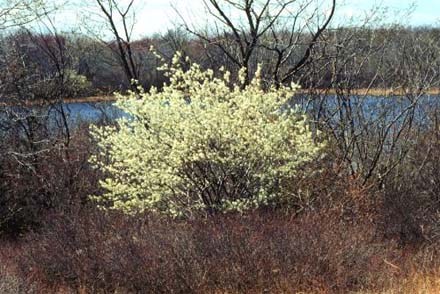
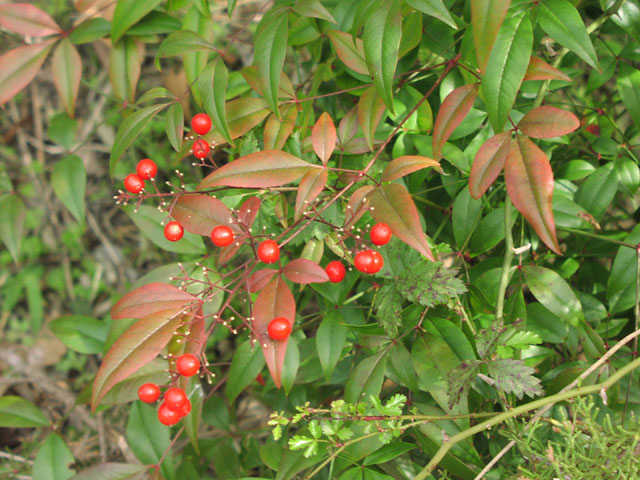
There are many pictures on-line, most of which are the property of commercial or educational sites. I do not have the time to ask permission for the number I would need to correctly attribute. If you have pictures which I may use and attribute of specific nandina cultivars, please contact me. I will try in the next few months to add pictures to this posting.
Recently, I was asked by Susan Harris (
Sustainable Gardening Blog) if
nandina species were invasive. Simple I thought; how difficult could this be? Wrapped in taxonomic confusion, marketed as a great plant with no pest problems,(
violating the Tallamy dynamic)
[1]: “
Nandina has no serious insect or disease pests and is an amazingly trouble-free plant”
[2], and featured in some cases, both as a perfect ornamental and an invasive within the same state, I have kept myself busy trying to arrive at a determination. [
picture: www.sbs.utexas.edu/]
As with many things in life which are important there is no easy answer to the question of
nandina invasiveness. Nandina is most likely an invasive species under specific conditions. As of this posting, I have not collected enough information to list the conditions, nor even suggest what they may be. I should think that if there is on-the-ground evidence of substantial invasion into significant area in a particular
eco-region, a gardener so
inclined to choose this species would choose some other species to plant. Please cinbtact me with pictures and specfic site information as to an invasion at
jpeter@behnkes.net.
From Florida, for example there is the following: “[A]
plant with such beautiful color and low maintenance has a place in any landscape. It can be used as a groundcover, shrub, hedge, screen, border, specimen, container or planter for mass planting or accent. It is splendid as a foundation plant if kept below five feet.” The same information sheet states further on: “
Nandina has invaded and become naturalized in woodlands of three counties in North Carolina. It has also invaded woodlands in northern Florida, Georgia and Alabama, displacing native vegetation. It has been found forming dense groves in habitats of Florida Caverns State Park, affecting the native flora. It has been reported as an invasive plant in Jackson, Gadsden, Leon, Wakulla and Citrus counties.”
[3]My unscientific, completely anecdotal research has led me to offer up an invasive species axiom. Because of the lack of funding for on-going study, I find that I must look at the invasive species much as the United States Supreme Court looked at pornography; I know it when I see it. This of course, means that I am offering a personal opinion as valid as any other. From Dave’s Garden site I read, “
On Jul 31, 2003, suncatcheracres from Old Town, FL wrote: Every home I have ever lived in the Coastal South has had some type of nandina in the yard, and I have never, ever, noticed that it was invasive. It may be that our plants were mostly in the shade, or in the back of borders, where they were never much fertilized, or that they never had any water other than rainwater. Or that the soil was quite sandy. But whatever the conditions, year in and year out, this was always an attractive, airy looking, evergreen shrub with beautiful fall and early winter red berries my mother cut for Christmas decorations.“
[4]There is also considerable information about the challenge of
nandina seed germination. From NC State University we find that “
Germination can be a challenge and is normally slow due to a rudimentary embryo and slow rate of embryo development. Fruits should be harvested when mature in the fall. Removal of the fleshy pulp is recommended and is easily accomplished by maceration. Seeds sown in the fall outdoors will germinate in 2 years.”
[5] Such information might well lead one to think there is limited invasive possibilities for
nandinas.
This anecdotal information is contrasted by more personal views such as “On Jul 30, 2003,
knightspassion from Raleigh, NC wrote: "
Heavenly bamboo is not aggressive in my North Carolina Piedmont garden. My nandina is in quite heavy shade in a woodland garden area and looks very nice with my other evergreen shrubs and trees e.g. euonymous and maples. It thrives even under drought conditions under maples that suck up all the water. I would not use this plant in a bed or in the sun since it could create a problem under good growing conditions. It seeds itself somewhat readily, and birds spread seed as well, but not anything that can't be kept up with in the shade if you don't want new plants.”
[6]North Carolina State University’s Department of Horticultural Science provides a description for the scientifically inclined. “
Nandina is a monotypic genus indigenous from India to central China (Huxley and others 1992; Krüssmann 1985; Ohwi 1984). It was introduced into Japan from China before the sixteenth century (Coats 1992). The species is a broadleaf evergreen, upright, flat-topped shrub reaching a height of 1.5 to 2.4 m with a spread of 1.0 to 1.5 m that can spread by root suckers into large colonies (Dirr 1990; Whitcomb 1996). Plants are characterized by numerous, unbranched stems with horizontal branches. However, with age, they tend to become leggy and open, unless pruned properly (Flint 1997). The species is hardy to USDA Zone 6 (Dirr 1990) and will remain evergreen in USDA Zones 7B8. It becomes deciduous when exposed to colder temperatures (Gibson 1982). In Japan, nandina is called nanten,Asacred-bamboo,@ as fruiting twigs are sold in winter to decorate altars, both in temples and private homes (Coats 1992; Krüssmann 1985; Richards and Kaneko 1988). There, nandina is planted close to the entrances of homes because the plant is used to comfort family members who have bad dreams. The wood has an aromatic flavor and is considered by the Japanese to be flavorful and suitable for toothpicks (Coats 1992). The plant is reputed to have medicinal properties effective in treatment of various ailments (Ikuta 1994). Nandina is cultivated commonly in the United States because of several desirable landscape attributes. The new, finely dissected leaves are bronze to red, becoming blue-green with age, and turning a dull purple to bright red in winter (Flint 1997). Flowers occur in large panicles held above the foliage and are followed in the fall by showy, bright red berries produced in clusters that persist throughout the winter. The stems give the appearance of bamboo (Flint 1997). Plants are adaptable to many different soils; they tolerate sun, shade, and drought; and they are pest free (Dirr 1990; Whitcomb 1996).”[7]Nandinas occur “…
under forest canopies and near forest edges. [The species] is shade tolerant. Seedlings [are] frequent in [the] vicinity of old plantings. [There is] varying leaf colors in the various cultivars, some of which do not produce viable seeds. [It] colonizes by root sprouts and spreads by animal-dispersed seeds. [Nandina domestica is] from eastern Asia and India [arriving] in the early 1800s. [It was] widely planted as an ornamental [and is] now escaped and spreading from around old homes.”[8]The following are
Nandina domestica cultivars unless otherwise noted
Cultivars and Varieties
·
Nandina domestica is a
broadleaf evergreen shrub growing 6 – 8 ft. high; Bluish-green leaves turning to reddish purple in winter. Flowers in May are 8 – 15 in. terminal
panicles opening to six-petaled, ¼ in. wide blooms, white with yellow anthers; Globular red fruit, 1/3 in., ripen in September and October and persist through the winter.
[9]· ‘
Alba’ is a 4- to 6-inch shrub with white berries and yellowish-green foliage, which turns yellow in fall. This
cultivar is more susceptible to cold damage than the species.
[10]· ‘
Arbor Dwarf'; is 1.5-2ft with ripe fruit on
Nandina domestica shrubby specimen of
Nandina domestica.
[11]· `
Colerno` (Patent PP11453). “
The present invention relates to a new and distinct cultivar of Nandina, botanically known as Nandina domestica, and hereinafter referred to by the cultivar name Colerno. The new Nandina is a product of a planned breeding program conducted by the Inventors in San Antonio, Tex. The objective of the breeding program was to create new Nandinas with unique leaf color. The new Nandina originated from a self-pollination of plants of an unnamed selection of Nandina domestica. The cultivar Colerno was discovered and selected by the Inventors as a single plant within a population of progeny plants in a controlled environment in San Antonio, Tex. in June, 1991. The selection of this plant was based on its unique and long-lasting dark red purple-colored young foliage in contrast to the typical green-colored young foliage of the other progeny plants. Asexual reproduction of the new Nandina by terminal cuttings taken in a controlled environment in San Antonio, Tex. has shown that the unique features of this new Nandina are stable and reproduced true to type in successive generations. Plants of the new Nandina have not been observed under all possible environmental conditions. The phenotype may vary somewhat with variations in environment such as temperature, daylength, light intensity, nutrition and water status without, however, any variance in genotype. The following traits have been repeatedly observed and are determined to be the unique characteristics of `Colerno`. These characteristics in combination distinguish `Colerno` as a new and distinct cultivar: 1. Upright, compact and dense plant habit. 2. Low vigor, slow growth rate. 3. Unique dark red purple-colored young foliage and dark green-colored mature foliage. Dark red purple color of young foliage is retained year-round.”
[12]· ‘
Compacta’ or dwarf
nandina only reaches 4 to 5 feet in height and has lacy foliage, which turns red in fall.
[13]· ‘
Compacta Nana’ or ‘Gulf Stream’TM is a slow-growing, 3- to 4- foot shrub with dark blue-green summer foliage and red winter foliage. It does not have any berries.
[14]· ‘
Firehouse’ Vivid reddish/purple color in the fall and winter.
[15]· ‘
Fire Power’ is a very compact plant to 2 feet tall and wide. It has red-tinged leaves in summer and bright red leaves in winter.
[16]· ‘
Greray’ (Patent PP08530) A new variety of
Nandina domestica having significant and improved characteristics not known to exist in either the variety "
Harbour Dwarf" of which this new plant is a genetic mutant or the general species
Nandina domestica. These characteristics include a symmetrical, densely mounding and compact form.
[17] “
This invention relates to the discovery and asexual propagation of a new and distinct variety of Nandina domestica (a member of the Berberidacia family that is commonly known as "Heavenly Bamboo"). The new plant variety was discovered as a mutant of the Nandina domestica nana cultivar named "Harbour Dwarf" in a cultivated bed of "Harbour Dwarf" plants that were growing in the Greenleaf Nursery Company, El Campo, Tex. The new variety of Nandina domestica nana has been named "Greray". The "Greray" mutant exhibited vastly different growing characteristics than those common to the "Harbour Dwarf" variety-particularly in that the "Greray" variety has a dwarf habit of growth when compared to the Nandina domestica progenitor "Heavenly Bamboo", but it is not as dwarf as its parent Nandina domestica nana "Harbour Dwarf". The new "Greray" variety is symmetrical, densely mounding and compact in form which differentiates and distinguishes it not only from its parent "Harbour Dwarf" and from its progenitor "Heavenly Bamboo", but also from related cultivars such as the variety called "Compacta". The new "Greray" cultivar is freely branching from basal and lateral buds and thus forms a tight compact globe. Its leaves are tripinnately compound. Testing and evaluation has shown the "Greray" variety to be stable in its distinguishing characteristics over several succeeding generations upon asexual propagation by using shoot cuttings and by tissue culturing at a nursery in El Campo, Tex. The "Greray" variety fully lives up to the "Heavenly Bamboo" common name often given to this family of plants. Orange hued new growth radiates crown-like upward while refreshing green mature growth extends horizontally to present a perky, full foliaged appearance. The refined texture of this plant is desirable for formal or casual settings. The fullness and controlled height of this dwarf nandina make it a prime choice when accent or foundation plantings are needed. The accompanying drawings illustrate the new "Greray" variety in color as grown in a nursery in El Campo, Tex. and also enable comparing "Greray" to its progenitor "Heavenly Bamboo", to its parent "Harbour Dwarf", and to another related Nandina domestica cultivar known as "Compacta"; the photographs also show the coloration of new, semi-mature and mature foliage of the new "Greray" variety.” [18]· ‘
Harbour Dwarf’ (
this plant was named for Mr. C.L.Harbour in 1956: my thanks for sending this information and the spelling correction to me September 2008 to Ralph Rushing, Rushing Nursery, Inc., 3220 Redstone Drive West, Semmes, Alabama 36575) is a freely spreading, low-growing (to 2 feet) plant. In some types, underground stems or rhizomes send up stems several inches from the parent plant, making it a good
groundcover. Winter foliage ranges in color from orange red to
bronzy red.
[19]· ‘
Jaytee’, ‘Harbour Belle’™ (Plant Patent No.14668) (
according to Mr. Rushing of Rushing Nursery in Alabama, 'Harbor Belle' is the correct spelling}; [sometimes known incorrectly as] Harbor Dwarf; Fine compound leaves with burgundy fall color; Grows 2 - 3 ft. tall. Flowers and berries reported.
[20]· ‘
Lowboy’ flowers and produces red berries, reaches 3 feet in height, and has red fall foliage.
[21]· ‘
Monfar’ ‘Sienna Sunrise’™ (Plant Patent No.14693); A new and distinct
nandina, characterized by its upright, mounded, dwarf and compact plant habit; developing leaves burgundy red in color; burgundy red coloration retained throughout the year; freely branching habit; and hardy to USDA Hardiness Zone 6B.
[22] Intense fiery red new foliage cools to lush medium green in summer. Red highlights reappear in fall and winter. Perfect choice for high profile accents or in mass groupings for intense color. Evergreen. Sun or part shade. Slow growth 3 to 4 feet tall, 2 to 3 feet wide. Cutting grown.
[23] “
The present invention relates to a new and distinct cultivar of Nandina, botanically known as Nandina domestica, and hereinafter referred to by the name ‘Monfar’. The new Nandina is a product of a cross-pollination during the spring of 1993 of two unidentified selections of Nandina domestica, not patented. The new Nandina was discovered and selected by the Inventor in a controlled environment in Earleville, Md. during the summer of 1996, as a single plant within the progeny resulting from the cross-pollination. Asexual reproduction of the new Nandina by cuttings taken in a controlled environment in Earleville, Md., since June, 1996, has shown that the unique features of this new Nandina are stable and reproduced true to type in successive generations. The cultivar Monfar has not been observed under all possible environmental conditions. The phenotype may vary somewhat with variations in environment and cultural practices such as temperature and light intensity without, however, any variance in genotype. The following traits have been repeatedly observed and are determined to be the unique characteristics of ‘Monfar’. These characteristics in combination distinguish ‘Monfar’ as a new and distinct cultivar of Nandina: Upright, mounded, dwarf and compact plant habit. Developing leaves burgundy red in color; burgundy red coloration retained throughout the year. Freely branching habit. Hardy to USDA Hardiness Zone 6B. Compared to plants of the parent selections, plants of the new Nandina are much more dwarf and have shorter internodes. Plants of the new Nandina also differ from plants of the parent selections in leaf coloration. In addition, plants of the parent selections usually produce flowers and berries whereas plants of the new Nandina do not produce flowers and berries. Plants of the new Nandina can be compared to plants of the Nandina cultivar Gulf Stream, disclosed in U.S. Plant Pat. No. 5,656. In side-by-side comparisons conducted in Earleville, Md., plants of the new Nandina differed from plants of the cultivar Gulf Stream primarily in developing foliage coloration as plants of the new Nandina produced burgundy red-colored leaves whereas plants of the cultivar Gulf Stream produced orange-colored leaves. Plants of the new Nandina can also be compared to plants of the Nandina cultivar Moon Bay, disclosed in U.S. Plant Pat. No. 5,659. In side-by-side comparisons conducted in Earleville, Md., plants of the new Nandina differed from plants of the cultivar Moon Bay in developing foliage coloration as plants of the new Nandina produced burgundy red-colored leaves whereas plants of the cultivar Moon Bay produced light green-colored leaves. In addition, plants of the new Nandina were larger than plants of the cultivar Moon Bay.”
[24]· ‘Moon Bay’™ (Plant Patent No. 5659); Dwarf with a mounded habit, 1 ½ - 2 ½ ft. high; Shiny, light green summer leaves with red hues in winter. No flowers reported.
[25] I am not sure about the cultivar name. Cultivar.
[26]· ‘
Monum’, ‘Plum Passion’™ (Plant Patent No. 12069); this nandina has new growth (which) is deep purplish red; deep green in summer; reddish purple in winter; narrow leaflets; moderate growth rate. 4 to 5 feet by 3 to 4 feet
[27] From the patent documentation: “
The present invention relates to a new and distinct variety of Nandina domestica, a member of the Berberidaceae family, commonly known as Heavenly Bamboo. This new `Monum` variety resulted from a naturally occurring, whole plant mutation discovered in a cultivated planting of the Nandina domestica variety `Compacta` (unpatented). `Monum` appeared different from `Compacta` plants growing in #5 nursery containers in Azusa, Calif., and was initially discovered around May 1993. The `Monum` variety differs from `Compacta` and other Heavenly Bamboo plants known to the inventor due to its narrower, longer leaf and its unique, vibrant seasonal foliage coloration. In the spring, the `Monum` foliage is deep purplish-red turning to dark green in the summer and reddish purple in the winter. Nandina domestica `Monum` has more vibrant seasonal foliage coloration than the parent Nandina domestica `Compacta` or any other known Nandina domestica cultivars known to the inventor. `Monum` has been asexually reproduced by shoot tip culture and cuttings since its discovery in 1993 in Azusa, Calif. However, via extensive asexual propagation of this plant and observation of resulting progeny, it has been proven that the novel, exceptional characteristics of this new variety are fixed, stable, and that the new variety reproduces true to type through asexual propagation.”[28]· ‘
Moyer’s Red’ is a tall-growing form, maturing to a height of 6 feet, which develops good cold weather red pigment in the leaves. The flowers and fruits are also pinker and redder than the species.
[29]· ‘
Nana’ or ‘
Nana Purpurea’ or ‘Atropurpurea Nana’ grows to 2 feet with mottled green foliage that turns purplish-red in winter.
[30] This plant does not flower or set fruit. ‘Atropurpurea Nana’ is a rather ugly, reddish plant
[31]· ‘'
Pygmaea' is a deciduous shrub which typically grows 4-5' tall (shorter in areas where it dies to the ground in winter). Features a clump of erect, cane- or bamboo-like stems with compound leaves which are divided into narrow, lacy leaflets (1-2" long). This cultivar grows shorter and has lacier foliage than the species. Leaves emerge coppery in spring, turn to green in summer and finally change to reddish-purple in fall. Tiny whitish flowers appear in late spring in loose, erect, terminal clusters (6-12" long). Flowers are followed by heavy sprays of red berries which persist from fall to spring, providing winter interest. Synonymous with the cultivars 'Compacta' and 'Nana'.
[32]· ‘
Richmond’ is slender and upright, much like the species plant, but with smaller, more delicate foliage. It looks a little more like a small tree. Tightly packed mauve-pinkish buds bloom white and are followed in autumn and winter by masses of shiny red berries which stay on the bush for months and are set off to advantage by the green leaves. The stems of this cultivar are also reddish.
[33]· '
Robinet' is without information
[34]·
'Royal Princess' is a large, upright shrub; Narrow leaves, turning reddish-purple in winter; Height of 6 - 8 ft. Small white flowers. Large panicles of bright red berries.
[35]· ‘
Sunray’ This nandina has small, star-shaped white flowers with compact growing, dense evergreen shrub-like habit, 4' tall by 3' wide. It has orange-red foliage in the winter and has copper leaves which when mature become a soft green.
[36] There is some internet indication that this trade-mark cultivar is Nandina ‘Greray”.
[37]· ‘
Umpqua Chief’ has new foliage emerges copper or purple-red and turns blue-green; Grows 5 - 6 ft. tall. White flowers followed by red berries.
[38]· ‘
Variegata’—a Japanese cultivar with light white variegation when grown in shade; grows to 3–6 ft at maturity.
[39]· ‘
Umpqua Princess’ is an upright shrub with evergreen leaves that change to reddish-purple in fall. It reaches a mature height of between three and five feet. Leaves are pinate to 3-pinate with lance-shaped leaflets. Bears conical panicles to 16 inches long, of small star-shaped, white flowers with large, yellow anthers. Red berry-like clusters are persistant through winter, and can be used in arrangements or eaten by birds. Found along the foundation of older homes, you may inherit a plant that needs some selective pruning. Do not whack the entire plant back so that all canes are the same height. Selectively prune, staggering the heights of each cane.
[40]· ‘
Umpqua Warrior’ reaches up to nine feet in height at maturity. It is an upright shrub with evergreen leaves that change to reddish-purple in fall. Leaves are pinate to 3-pinate, with lance-shaped leaflets. Bears conical panicles, to 16 inches long, of star-shaped, white flowers with large, yellow anthers. An abundance of red berry-like clusters are persistant through winter, and can be used in arrangements or eaten by birds. Found along the foundation of older homes, you may inherit a plant that needs some selective pruning.
[41]· ‘
Woods Dwarf’ is a rounded form to 4 feet with dense, crimson red foliage in winter.
[42]· ‘
Yellow Berries’ is similar to the species but the foliage lacks the typical reddish tinge.
[43] The berries are yellow.
[44]·
Nandina filamentosa 'Threadleaf', known also as
'San Gabriel' and '
Kirajuse' Finely dissected leaves give this plant a lacy, fern-like appearance; New foliage is reddish becoming bright green in summer and turning orange, bronze or purplish red in fall; Slow growing; Some sources give a mature height of 1 - 2 ft., others say 3 - 4 ft. Pinkish white flowers reported in late spring and summer.
[45]In the interesting but not entirely relevant section of this essay we find some interesting factoids. “Cyanide poisoning has occurred when livestock have eaten the berries, although birds eat the berries without concern. Keep them away from young children or those who might find the attractive bright red fruit interesting enough to put into their mouths. If the plants are in an area where young children might have access to the attractive red fruit, prune off the flower panicles after the spring bloom for several years. The berries have been used in holiday decorations, where they should be kept away from little fingers. Domestic pets do not seem to be attracted to the fruit. This plant has hit the invasive plant list in a number of states. It has not been identified as a problem yet in California, but keep a careful watch. If you see Nandina suckers appearing in areas where they are not desired, the plant may be spreading out of bounds.
[46] I must assume that if you follow the dead heading practice stated above, you will one keep it from being too invasive and too eliminate a major reason to use it in a landscape.
Continuing the theme of interestingly non-invasive information we found medicinal uses for nandina. “The roots and stems are antitussive, astringent, febrifuge, stomachic and tonic[147
[47], 74
[48]]. A decoction is used in the treatment of fever in influenza, acute bronchitis, whooping cough, indigestion, acute gastro-enteritis, tooth abscess, pain in the bones and muscles and traumatic injuries[147]. It is especially useful in the treatment of children's coughs[174]. There is a danger that an overdose can cause respiratory paralysis[174]. A decoction of the leaves is tonic[218
[49]]. The fruit is febrifuge and tonic[218]. Another report says that it is toxic, so great care should be employed if using it[147]. The root is antirheumatic[218]. Young shoots contain high concentrations of laetrile - up to 20% on a zero moisture basis[218].”
[50]“Much like beautyberry, nandina is a naturalizing plant. It is considered invasive in the mountainous regions of South Carolina, but not on the coastal plain.”
[51] I would venture to say that Nandina spp. are dynamic opportunists which can exploit favorable conditions creating situations which could be labeled invasive. “In the right setting, it's a lovely shrub. In a mixed border, or in the wrong setting, it's invasive and aggressive, spreading by underground runners and getting too tall too quickly. We've removed several LARGE shrubs that were planted in front of windows, and effectively blocked all light coming into the room; two years later, we're still finding new sprouts that keep popping up.
[52] Perhaps the hint of potential trouble for natural areas can be found in “Be certain you really, really like this plant and want to keep it forever. It is extremely difficult to get rid of, as even the smallest piece of root will resprout.”
[53]States with suspected infestations are shown in gray.
[54]As a parting note, given the completely anecdotal nature of this species review, I offer up the Global Compendium of Weeds listing of attributes and in the notes the reference citations. “agricultural weed, cultivation escape, environmental weed, garden thug, naturalised, sleeper weed, weed”
[55][1] Insects and plants evolve together and a result is the abilty of certain insects to eat certain species specifically. Planting eco-region aliens which are genetically inedible reduces biological diversity. Traditional gardeners look for plants which are not eaten by insect life which tend to be exotic species. This nandinas, which are sold for many reasons, are desirable plants for traditional gardeners because they do not need applications of pesticides. So gardeners can claim to be environmentally friendly beacise of the reduced use of chemicals.
[2] David Hensley and Jay Deputy; Department of Horticulture Published by the College of Tropical Agriculture and Human Resources (CTAHR) and issued in furtherance of Cooperative Extension work, Acts of May 8 and June 30, 1914, in cooperation with the U.S. Department of Agriculture. Charles W. Laughlin, Director and Dean, Cooperative Extension Service, CTAHR, University of Hawaii at Manoa, Honolulu, Hawaii 96822.L
http://www.ctahr.hawaii.edu/oc/freepubs/pdf/OF-26.pdf[3] Seminole County Government 1101 East First Street Sanford, FL 32771 407-665-0311:
http://www.seminolecountyfl.gov/commsrvs/coopext/articles.asp?articleID=524[4] © 2000-2008 Dave's Garden. All Rights Reserved
[5] Overcoming Seed Dormancy: Trees and Shrubs , 1/99 HIL-8704, Erv Evans, Extension Associate
Frank A. Blazich, Professor Department of Horticultural Science:
http://www.ces.ncsu.edu/depts/hort/hil/hil-8704.html[6] © 2000-2008 Dave's Garden. All Rights Reserved; Jul 30, 2003, knightspassion from Raleigh, NC wrote:
http://davesgarden.com/guides/pf/go/1547/[7] Dr. Jull is an assistant professor at the University of Wisconsin=s Department of
Horticulture, Madison, Wisconsin; Dr. Blazich is professor of plant propagation and tissue culture
at North Carolina State University’s Department of Horticultural Science, Raleigh, North Carolina.
http://www.nsl.fs.fed.us/wpsm/Nandina.pdf[8] The Bugwood Network, USDA Forest Service & USDA APHIS PPQ. The University of Georgia - Warnell School of Forest Resources and College of Agricultural and Environmental Sciences - Dept. of Entomology Last updated on Wednesday, November 05, 2003 at 01:37 PM Questions and/or comments to the Bugwood Webmaster:
http://www.invasive.org/eastern/srs/SB_N.html[9] Sandra Wilson (IRREC) and Gary Knox (NFREC), Department of Environmental Horticulture, UF:
http://64.233.169.104/search?q=cache:FcVGNUT5TbwJ:www.fngla.org/reports/58/report1.pdf+nandina+cultivar&hl=en&ct=clnk&cd=7&gl=us [10] Prepared by Marjan Kluepfel, HGIC Information Specialist, and Bob Polomski, Extension Consumer Horticulturist, Clemson University:
http://hgic.clemson.edu/factsheets/hgic1071.htm[11] © 2004 Arizona Board of Regents. All contents copyrighted. All rights reserved.
http://ag.arizona.edu/pima/gardening/aridplants/Nandina_domestica.html[12] Copyright 2004-2007 FreePatentsOnline.com. All rights reserved
http://www.freepatentsonline.com/PP11453.html[13] Prepared by Marjan Kluepfel, HGIC Information Specialist, and Bob Polomski, Extension Consumer Horticulturist, Clemson University:
http://hgic.clemson.edu/factsheets/hgic1071.htm[14] Prepared by Marjan Kluepfel, HGIC Information Specialist, and Bob Polomski, Extension Consumer Horticulturist, Clemson University:
http://hgic.clemson.edu/factsheets/hgic1071.htm[15] © 2000-2008 Dave's Garden. All Rights Reserved; Apr 2, 2006, Suze_ from Bastrop County, TX
(Zone 8b)
http://davesgarden.com/guides/pf/go/86799/[16] Prepared by Marjan Kluepfel, HGIC Information Specialist, and Bob Polomski, Extension Consumer Horticulturist, Clemson University:
http://hgic.clemson.edu/factsheets/hgic1071.htm[17] Copyright 2004-2007 FreePatentsOnline.com. All rights reserved
http://www.freepatentsonline.com/PP08530.html[18] Copyright 2004-2007 FreePatentsOnline.com. All rights reserved.:
http://www.freepatentsonline.com/PP08530.html?highlight=nandina,domestica&stemming=on [19] Prepared by Marjan Kluepfel, HGIC Information Specialist, and Bob Polomski, Extension Consumer Horticulturist, Clemson University:
http://hgic.clemson.edu/factsheets/hgic1071.htm[20] Sandra Wilson (IRREC) and Gary Knox (NFREC), Department of Environmental Horticulture, UF:
http://64.233.169.104/search?q=cache:FcVGNUT5TbwJ:www.fngla.org/reports/58/report1.pdf+nandina+cultivar&hl=en&ct=clnk&cd=7&gl=us [21] Edward F. Gilman, professor, Environmental Horticulture Department, Cooperative Extension Service, Institute of Food and Agricultural Sciences, University of Florida, Gainesville, 32611: This document is Fact Sheet FPS-421, one of a series of the Environmental Horticulture Department, Florida Cooperative Extension Service, Institute of Food and Agricultural Sciences, University of Florida. Publication date: October, 1999 Please visit the EDIS Web site at
http://edis.ifas.ufl.edu/:
http://hort.ifas.ufl.edu/shrubs/NANDOMA.PDF[22] Copyright 2004-2007 FreePatentsOnline.com. All rights reserved.:
http://www.freepatentsonline.com/PP14693.html[23] Monrovia:
http://www.monrovia.com/monroviaweb.nsf/8c104835579b67e18825685f006acdf8/ea3c57b002bd386185256f5b00801572!OpenDocument[24] Copyright 2004-2007 FreePatentsOnline.com. All rights reserved.:
http://www.freepatentsonline.com/PP14693.html[25] Sandra Wilson (IRREC) and Gary Knox (NFREC), Department of Environmental Horticulture, UF:
http://64.233.169.104/search?q=cache:FcVGNUT5TbwJ:www.fngla.org/reports/58/report1.pdf+nandina+cultivar&hl=en&ct=clnk&cd=7&gl=us [26] The chaos in the industry as to the correct use of trade marks and patents, varietal appellations and cultivar designation is robust and on-going. .
[27] Select Nandina domestica Cultivars:
http://www.ces.ncsu.edu/depts/hort/consumer/factsheets/shrubs/cultivars/nandina_domestica-table.html[28] Copyright 2004-2007 FreePatentsOnline.com. All rights reserved
http://www.freepatentsonline.com/PP12069.html[29] Prepared by Marjan Kluepfel, HGIC Information Specialist, and Bob Polomski, Extension Consumer Horticulturist, Clemson University:
http://hgic.clemson.edu/factsheets/hgic1071.htm[30] Prepared by Marjan Kluepfel, HGIC Information Specialist, and Bob Polomski, Extension Consumer Horticulturist, Clemson University:
http://hgic.clemson.edu/factsheets/hgic1071.htm[31] Edward F. Gilman, professor, Environmental Horticulture Department, Cooperative Extension Service, Institute of Food and Agricultural Sciences, University of Florida, Gainesville, 32611: This document is Fact Sheet FPS-421, one of a series of the Environmental Horticulture Department, Florida Cooperative Extension Service, Institute of Food and Agricultural Sciences, University of Florida. Publication date: October, 1999 Please visit the EDIS Web site at
http://edis.ifas.ufl.edu/:
http://hort.ifas.ufl.edu/shrubs/NANDOMA.PDF[32]© Missouri Botanical Ga rden, 2001-2006:
http://www.mobot.org/gardeninghelp/plantfinder/plant.asp?code=L240[33] © 2000-2008 Dave's Garden. All Rights Reserved On Dec 9, 2004, smiln32 from Oklahoma City, OK
(Zone 7a)
http://davesgarden.com/guides/pf/go/86802/[34] © 2000-2008 Dave's Garden. All Rights Reserved On Dec 9, 2004
http://davesgarden.com/guides/pf/b/Berberidaceae/Nandina/domestica/cultivar/0/[35] Sandra Wilson (IRREC) and Gary Knox (NFREC), Department of Environmental Horticulture, UF:
http://64.233.169.104/search?q=cache:FcVGNUT5TbwJ:www.fngla.org/reports/58/report1.pdf+nandina+cultivar&hl=en&ct=clnk&cd=7&gl=us [36] Copyright 2008 Lancaster Farms, Inc. All rights reserved:
http://www.lancasterfarms.com/cgi-bin/orderdetails.pl?upc=12345609910&textPassword=&guide=yes[37] JC Raulston Arboretum, Department of Horticultural Science, NC State University, Campus Box 7522
Raleigh, NC 27695-7522; (919) 515-3132
http://www.ncsu.edu/jcraulstonarboretum/photography/photograph_collection/photograph_collection_family_name_listing.php [38] Sandra Wilson (IRREC) and Gary Knox (NFREC), Department of Environmental Horticulture, UF:
http://64.233.169.104/search?q=cache:FcVGNUT5TbwJ:www.fngla.org/reports/58/report1.pdf+nandina+cultivar&hl=en&ct=clnk&cd=7&gl=us [39] David Hensley and Jay Deputy; Published by the College of Tropical Agriculture and Human Resources (CTAHR) and issued in furtherance of Cooperative Extension work, Acts of May 8 and June 30, 1914, in cooperation with the U.S. Department of Agriculture. Charles W. Laughlin, Director and Dean, Cooperative Extension Service, CTAHR, University of Hawaii at Manoa, Honolulu, Hawaii 96822.L
http://www.ctahr.hawaii.edu/oc/freepubs/pdf/OF-26.pdf[40] BackyardGardener.com
http://www.backyardgardener.com/plantname/pd_49a0.html[41] BackyardGardener.com:
http://www.backyardgardener.com/plantname/pd_9a73.html[42] Prepared by Marjan Kluepfel, HGIC Information Specialist, and Bob Polomski, Extension Consumer Horticulturist, Clemson University:
http://hgic.clemson.edu/factsheets/hgic1071.htm[43] Prepared by Marjan Kluepfel, HGIC Information Specialist, and Bob Polomski, Extension Consumer Horticulturist, Clemson University:
http://hgic.clemson.edu/factsheets/hgic1071.htm[44] Prepared by Marjan Kluepfel, HGIC Information Specialist, and Bob Polomski, Extension Consumer Horticulturist, Clemson University:
http://hgic.clemson.edu/factsheets/hgic1071.htm[45] Sandra Wilson (IRREC) and Gary Knox (NFREC), Department of Environmental Horticulture, UF:
http://64.233.169.104/search?q=cache:FcVGNUT5TbwJ:www.fngla.org/reports/58/report1.pdf+nandina+cultivar&hl=en&ct=clnk&cd=7&gl=us [46] Published in the Contra Costa Times on December 26, 2003:
http://ccmg.ucdavis.edu/CCTimes/122603.htm[47] A Barefoot Doctors Manual. Running Press ISBN 0-914294-92-X
[48] Kariyone. T Atlas of Medicinal Plants.
[49] Medicinal Plants of China Reference Publications, Inc. 1985 ISBN 0-917256-20-4, Duke. J. A. and Ayensu. E. S.
[50] Plant information taken from the Plants For A Future - Species Database. Copyright (c) 1997-2000.
WEB search engine by Rich Morris - Home Page- Contact Info: Plants for a Future, Blagdon Cross, Ashwater, Beaworthy, Devon, EX21 5DF, UK.
http://www.ibiblio.org/pfaf/cgi-bin/arr_html?Nandina+domestica[51] Copyright © 1997 - 2008 the Evening Post Publishing Co.:
http://www.charleston.net/news/2007/nov/04/berried_treasures21028/[52] © 2000-2008 Dave's Garden. All Rights Reserved: On Aug 31, 2001, Terry from Murfreesboro, TN
(Zone 7a) wrote:
http://davesgarden.com/guides/pf/go/1547/[53]© 2000-2008 Dave's Garden. All Rights Reserved: On Jan 25, 2003, jkom51 from Oakland, CA, (Zone 9b) wrote:
http://davesgarden.com/guides/pf/go/1547/[54] http://www.invasive.org/eastern/srs/SB_N.html
[55] Citations copied with errors and errata directly from:
http://www.hear.org/gcw/species/nandina_domestica/Bargeron, C.T., D.J. Moorhead, G.K. Douce, R.C. Reardon & A.E. Miller (Tech. Coordinators). 2003. Invasive Plants of the Eastern U.S.: Identification and Control. USDA Forest Service - Forest Health Technology Enterprise Team. Morgantown, WV USA. FHTET-2003-08 (CD version: Nov 2003)
Faith T. Campbell; American Lands Alliance; "Worst" Invasive Plant Species in the conterminous United States: weed (environmental weed)
Staples, George W., Derral Herbst & Clyde T. Imada (2000). Survey of Invasive or Potentially Invasive Cultivated Plants in Hawaii. A Special Publication of the Records of the Hawaii Biological Survey for 1999. Honolulu, Hawaii. (cultivation escape, environmental weed)
Germplasm Resources Information Network G.R.I.N. GRIN (naturalised)
Groves, R.H. & Hosking, J.R. (1997) Recent Incursions of Weeds to Australia. Technical Series N° 3. CRC for Weed Management Systems, Australia. (weed)
Introduced (Naturalised) Species to the United States [USDA, NRCS 1999. The PLANTS database. National Plant Data Center, Baton Rouge, LA 70874-4490 USA. ] (naturalised)
Invasive and Exotic Weeds. Invasive List: The Source for Information and Images of Invasive & Exotic Species. A joint project of The University of Georgia's Bugwood Network, USDA Forest Service and USDA APHIS PPQ.
John Hosking, NSW Department of Agriculture, Weed Database 30 April 2003 (environmental weed, naturalised)
List of Florida's Most Invasive Species - Florida Exotic Pest Plant Council. (environmental weed)
Mulvaney, M.J. (1991). Far from the Garden Path: An Identikit Picture of Woody Ornamanetal Plants Invading South-Eastern Australian Bushland. PhD Thesis. Dept. Biogeography and Geomorphology, Research School of Pacific Studies. Australian National University (weed)
Randall, J.M. and Marinelli, J. eds (1996) Invasive plants: Weeds of the global garden. Brooklyn Botanical Garden Publications, Brooklyn, New York. [Ornamentals Invading Natural Areas in the Continental United States.] (environmental weed, garden thug)
Randall, R.P. & Kessal (agricultural weed, naturalised)
Randall, R.P. (2001). Garden thugs, a national list of invasive and potentially invasive garden plants. Plant Protection Quarterly 16 (4), 138-171. (garden thug, sleeper weed)
tion for its collections databases. Some groups in this list have been thoroughly scrutinized and do, in fact, represent an essentially complete checklist for the Hawaiian Islands. Other groups, however, are NOT complete, and only represent an unverified listing of what happens to be in the Bishop Museum specimen collection database. (naturalised)
The Exotic Plants of Southern Florida. Exotic Specifics. The Institute for Regional Conservation George D. Gann and Keith A. Bradley irc@regionalconservation.org 22601 S.W. 152 Ave. Miami, Florida 33170. (weed)
Wagner, W.L., Herbst, D.R. and Lorence, D.H. (2005). Naturalised Flora of the Hawaiian Islands website. (04/25/2006) (naturalised)
Wang, Z., Xin M., Ma D., Song, S., Wang, X., Yan, C., Zhang, D., Feng, W., Ma, E. and Chen, J. (1990). Farmland Weeds in China. A collection of coloured illustrative plates. Agricultural Publishing House. China. (agricultural weed, environmental weed)
d Resource Studies, University of Waterloo, Waterloo, ON, N2L 3G1 Cananon. (2002). The Common Weeds of Central Thailand. Weed Science Society of Thailand. (weed)
pbell; American Lands Alliance; Worst Invasive Plant Species in the conterminous United States: weed
Germplasm Resources Information Network G.R.I.N. GRIN