We spoke with John Peter Thompson of the National Invasive Species Council Advisory Committee (ISAC) about stalwart ornamental plants you may be growing that have invasive characteristics. Part one of a series. This podcast focuses on problem plants east of the Mississippi, excluding Florida.
Showing posts with label gardening. Show all posts
Showing posts with label gardening. Show all posts
Sunday, February 02, 2014


Saturday, January 19, 2013
Invasive species 'boxbug' tries to sneak past APHIS
 |
| Gonocerus acuteangulatus (Goeze 1778) boxbug image from British Bugs web site |

Invasive species are all around
us. The eat our lunch, they make us sick, and they change our landscapes.
Invasive species cost us money...lots of money...some say over 130 billion
dollars a year in the United States alone. Most of only get excited about
invasive species when they directly and immediately injure us personally. We remain landscape illiterate convinces that
food comes from stores, and clean water from pipes.
The United States Department of
Agriculture's Animal and Plant Health Inspection Service (USDA APHIS) works to
stave off the introduction and establishment of harmful invasive species.[1]
APHIS and its ever-smaller budgets is faced with more "stuff' coming in to
US ports each year. And who is APHIS' stakeholder that should be clamoring for
increases to protect our pockets, food, and health? Why we the very people who
have no clue. Somehow we have the idea that the
infrastructure started by Lincoln and enhanced by Presidents through the 1960s
now needs no support at all. Our arrogance is only unsurpassed by our inability
to see tomorrow.
If you live in the Mid-Atlantic
you already know about the stink bug because it decided to not only cost the
fruit industry millions but more importantly for you, because it moved in by
the thousands to your personal space and caused you discomfort. So you call on
APHIS and demand to know why and then fail to give it the money to prevent the
next critter from moving in.
With little support from the
calmly disinterested public (those without stink bugs, pythons, flying fish and
rock snot in their lives so far), the dedicated employees of APHIS and its sister
organizations ARS and the Forest Service) work to keep the next invader out of
your personal space. They work tirelessly to safeguard the United States much
like the heroic 'Little Dutch boy' who stuck his finger in a hole in the dike
to save his world from certain doom.
And
what has APHIS done lately for you - especially those of you who garden or make
your living selling plants? In December, the keen eyes of USDA APHIS port
inspectors in Baltimore, Maryland spotted for the first time a Coreid, Gonocerus acuteangulatus (Goeze 1778). G. acuteangulatus, commonly called known
as a boxbug in the United Kingdom, id a "relatively large reddish-brown
squashbug, distinguished from the commoner Coreus
marginatus by the narrower abdomen and more pointed lateral extremities of
the pronotum. Nymphs have a green abdomen." The website,
British Bugs, goes on to describe this new invader to the US as historically
very rare in the British Isles and known only from Box Hill in Surrey, where it
feeds on box trees (boxwoods). British Buigs continues its report noting that
the "bug is expanding its range and now occurs widely in the south-east of
England and beyond. It is exploiting different foodplants, and has been found
on hawthorn, buckthorn, yew and plum trees." Reports from England report
that it seems prefers berry bearing species such as hollies and ivies.[2]
The boxbug is also reported as a major
problem for hazelnut production in Italy.[3]
APHIS
also reports that the recently intercepted boxbug, G. acuteangulatust is a primary pest of boxwood, but is also
recorded feeding on important landscape and garden plants such as hawthorn,
buckthorn, yew and plum trees. According to a report in the Washington Times,
the boxbug, referred to as a squashbug in the article, was "destined for Eldersburg, Md. CBP (U.S. Customs and Border Protection)
issued an Emergency Action Notification to the importer requiring the shipment
to be re-exported or destroyed."[4]
The possible introduction of this
invasive pest would add to the litany of invasive species problems facing
farmers and gardeners in the United States. We, all of us, should be actively supporting
enhanced funding for USDA APHIS. It is worth noting that APHIS also quietly
protects natural areas from invasive species that creep through our trade
routes into our ports and out into our fields and woods.
[1] The
Animal and Plant Health Inspection Service is a multi-faceted Agency with a
broad mission area that includes protecting and promoting U.S. agricultural
health, regulating genetically engineered organisms, administering the Animal
Welfare Act and carrying out wildlife damage management activities. These efforts support the overall mission of
USDA, which is to protect and promote food, agriculture, natural resources and
related issues.
To protect agricultural health, APHIS is on the job 24
hours a day, 7 days a week working to defend America’s animal and plant
resources from agricultural pests and diseases.
For example, if the Mediterranean fruit fly and Asian longhorned beetle,
two major agricultural pests, were left unchecked, they would result in several
billions of dollars in production and marketing losses annually. Similarly, if foot-and-mouth disease or
highly pathogenic avian influenza were to become established in the United
States, foreign trading partners could invoke trade restrictions and producers
would suffer devastating losses. http://www.aphis.usda.gov/about_aphis/
[2] The
Essex Field Club. http://www.essexfieldclub.org.uk/portal/p/Species+Account/s/Gonocerus%20acuteangulatus
[3]
Vaccino et al. 2008. Detection of damage due to bug feeding on hazelnut and wheat
by biochemical techniques. Bulletin of Insectology 61 (1): 189-190.
[4] Jerry
Seper. December 12, 2012. ‘Squashbug’
nabbed at Baltimore Harbor. The Washington Time. [accessed January 19,
2013] http://www.washingtontimes.com/news/2012/dec/12/squashbug-nabbed-baltimore-harbor/
"The importer plans to
fumigate.
Upon Friday’s discovery of
the bug, CBP forwarded the specimen to a USDA Animal and Plant Health
Inspection Service Plant Protection and Quarantine entomologist for
identification. CBP agriculture specialists work closely with USDA to protect
the nation’s agriculture resources against the introduction of foreign plant
pests and animal diseases.
CBP agriculture specialists
have extensive training and experience in the biological sciences and
agricultural inspection. On a typical day, they inspect tens of thousands of
international air passengers, and air and sea cargoes nationally being imported
to the United States and seize 4,291 prohibited meat, plant materials or animal
products, including 470 insect pests."
Read more:
http://www.washingtontimes.com/news/2012/dec/12/squashbug-nabbed-baltimore-harbor/#ixzz2IQluwQPK
Follow us: @washtimes on Twitter
Wednesday, March 28, 2012
Next up: Boxwood Blight - Invasive Species Impact Everyone
 |
| http://www.hgic.umd.edu/content/images/rowofinfectedBoxwoodsinCTSharonDouglas_low.jpg |
The
rapid expansion of the number of invasive species causing harm to existing
ecosystem services and resources should be cause for some modicum of attention
even if not alarm. The gardening industry is mostly dismissive of the impact of
invasive species unles and until they affect ornamental horticulture, at which
time there is a focus on the organisum causing the problem not the problem as a
while. Soit is that fast on the heels )legs) of the marmorated stink bug[1]
comes a new disease that attacks one of the mainstays of the garden landscape,
the boxwood, or as some call it, the box.
The new
disease is referred to now as box blight, Cylindrocladium
pseudonaviculatum (synonym: Cylindrocladium
buxicola). The disease has only been observed on leaves and shoots of Buxus spp. in nature. As with most exotic,
alien,, novel, introduced species, full host range of this species is not fully
known. And to make things more interesting, there appears to be no published
evidence of resistance to this fungus in the many commercially available boxwood species. The invasive species attacks
both the non native, English boxwood, (Buxus
semperviens ‘Suffruticosa’ ), as well as the non-native American box, Buxus sempervienand Korean box, Buxus microphylla var. koreana. Controlled laboratory test show that the fungus
can attack other species in the boxwood family such as Sarcococca and Pachysandra. [2]
According
to the Maryland Home and Garden Center,
"Box Blight or Boxwood Blight has been
causing defoliation of boxwoods throughout Europe since the late 1990’s. In
October, 2011, the disease was found in North Carolina and Connecticut in both
nursery, and landscape plantings. The disease was also found in a Virginia
nursery. Since this first US report the disease has been identified in a number
of northeastern states and also in Oregon, and British Columbia. The first
Maryland case of Boxwood Blight was confirmed on plants from a landscaper’s
nursery in December, 2011. The first symptoms begin as leaf spots followed by
rapid browning and leaf drop starting on the lower branches and moving upward
in the canopy."
"The key symptoms that
differentiate Boxwood Blight from other boxwood diseases, such as Volutella
Blight and Macrophoma Leaf Spot, are numerous narrow black cankers (black
streaks) that develop on the green stems. The pathogen does not attack the roots, so
larger plants may produce new leaves during the growing season, but may lose
ornamental value as defoliation becomes severe. Repeated defoliation and
dieback from stem cankers has killed small rooted cuttings in nursery
propagation. The causal fungus can remain in alive in fallen leaves which can
then serve as the source of infection for subsequent years."[3]
The
continuing introduction, establishment and spread of species that have not
developed interactions and relationships with indigenous species is causing
major shifts in the expected services and resources of our ecosystems. We depended
on these ecosystems to clean the water, control its movement, supply refugia
for diversity, supply our food, feed, fiber, forage, flower, fish and forest
needs as well as to create an landscape hospital to our human psychological desires.
And most of us see not problem in the slow fire of ecological destruction and
resource disturbance because it is happening at a rate of change that is slower
than our current news cycle. By the time we see an invasive species problem; by
the time it reaches out and directly impacts us individually, the cost of
recovery is beyond our reach and we are in adaptation mode at best.
[1]
Thompson, John Peter. Stink bug species invades our space. September 18, 2010.
[accessed March 28, 2012] http://ipetrus.blogspot.com/2010/09/stink-bug-species-invades-our-space.html
[2] USDA-APHIS-PPQ-CPHST
and NCSU-Department of Plant Pathology, Mountain Horticultural Crops Research and
Extension Center (MHCREC). The ‘box blight’ pathogen: Cylindrocladium
pseudonaviculatum = Cylindrocladium buxicola (Teleo. Calonectria
pseudonaviculata). [accessed March 28, 2012]
[3]
Maryland Home and Garden Information Center. Box Blight. [accessed March 28, 2012] http://www.hgic.umd.edu/content/otherinvasive.cfm#Blight
Tuesday, May 31, 2011
On the Sowing of Flower Seeds - The Maryland Farmer and Mechanic. June 1, 1864
In order to be successful in raising flowers from seeds, it will be necessary to bear in mind that the smaller the seed the less deeply should it be covered with earth. Some seeds are so small that they require only to be sprinkled over the ground and gently pressed into the soil, and should the weather prove very dry, a thin layer of damp moss ought to be placed over them til they germinate, when care must be taken to have it removed. There are few seeds that require such extreme attention.
Small seed such as Petunia, Portulacca, &c sow about one-eight (sic) of an inch in depth; those of larger sizes as Mignonette, Sweet Alyssum, &c, about one quarter of an inch in depth; still larger as Balsam, Morning Glory, &c, three quarters off an inch in depth; and seeds of the largest size as Nasturtium, Lupine, &c, fully one inch in depth. They must be covered with finely pulverized soil, or leaf mold slightly pressed down, and should be kept moderately moist by shading or slightly sprinkling of water, until they make their appearance. Tall varieties should be neatly staked to prevent injury from wind or rain.
Transcribed from: On the Sowing of Flower Seeds - The Maryland Farmer and Mechanic. June 1, 1864. p. 183
Thursday, May 26, 2011
Rhubarb Wine Recipe from June 1, 1864; Maryland Farmer and Mechanic
Maryland Farmer and Mechanic. June 1, 1864. Baltimore. S. S. Mills & Co. p. 191
"Domestic Recipes"
Rhubarb Wine - Peel and slice as for pie; put a very small quantity of water in the vessel, only just enough to cover the bottom; cover the vessel and gradually bring to a slight boil; then strain, pressing out all the liquid; to this liquid add an equal quantity of water; to each gallon (after mixing) add from four to five pounds of brown sugar; set aside, ferment and skim like currant wine; leave ion the cask and bulk as long as possible before sending away. - All wine is better kept in casks.
 |
| Image: University of Illinois Extension |
**************************************
WARNING
Never eat rhubarb leaves, cooked or raw. Eating the leaves can be poisonous because they contain oxalate. This toxin, plus another unknown toxin also found in the leaves, has been reported to cause poisoning when large quantities of raw or cooked leaves are ingested. http://www.fruitsandveggiesmatter.gov/month/rhubarb.html
see complete transcription of recipes at: http://ipetrus.blogspot.com/2011/05/domestic-recipes-complete-transcription.html
Wednesday, June 16, 2010
Saturday, March 20, 2010
Invasive Plants & Butterfiles - A Collision of Desires
Spring has sprung in Washington and with it comes the fulfillment of the pent up urge to go out side and garden, to become one with nature, and to do good. On Twitter this morning (@InvasiveNotes) I found this tweet: @ionxchange: 75 Plants That Attract Butterflies Mistkitscom blog http://bit.ly/aS2f1i . This inherent goodness and wholesomeness of planting flowers and encouraging pollinators especially the ostentatious, non threatening butterflies compels attention and gives form to a garden plan of action. The dream of shirking clouds of summer iridescence draws us to lists of plants that are known to attract the butterfly.
If you truly want butterflies of course you need to provide them plants that help them more than just at the end of their lives. For before there is the wonder of the shimmering display of summer garden visitors there is the caterpillar eating its way through your garden securing a resting place mostly oblivious as it hide from your brood of song birds waiting for a meal. And worse perchance if you use chemicals, the caterpillar which can reduce a favorite spring plant to a stems and stalks is easily killed by wanton chemical applications. While butterflies are feeding off nectar and are not to particular as to the source, they are usually specialists in their fuzzy not so glorious to some caterpillar stage of life. In other words caterpillars tend to be specialists feeding on only one species of plant, not necessarily the one that you would plant for summer season flowering fireworks. And sometime the plant species with which they have evolved is one you also want to eat, thereby creating a collision of desires. Do you want the parsley, fennel and dill or the Black swallowtail, Papilio polyxenes asterius Stoll?
To me then falls the Grinch’s role of pointing our gingerly that there is a collision of desires lurking within the wonderfully created list. Invasive species, garden thugs that quickly climb the garden fence and escape into natural areas upsetting the native balance and sometimes displacing most of the native diversity prized in natural settings can be dangerous beauties. (Dangerous Beauty and other Invasive Species Traps Monday, May 25, 2009) In our fascination with homogenizing the world’s landscapes, we seek garden plants that will grow from Arizona to Maine and include Alaska and Hawaii too. Armed with this list we select those plants that are known to produce nectar in quantities readily available for the more flamboyant lepidopterans. We are not choosing plants for the caterpillars and in fact our one-size-fits-all lists have been written in part show-case plants that are not greatly affected by the endless hunger of caterpillars.
So in come waltzing the invasive species: butterfly bush, (non native) honeysuckles, privet, (non native) wisteria disguised because in deed they will supply nectar to butterflies even as they do not provide a food source for the caterpillars. Because invasive species are a global issue determined locally, what is invasive in your area o=is not necessarily invasive for some one in another part of the country. Many perennials like some species of daylilies, ground covers like English ivy, and beautiful shade trees like saw-tooth oaks may be invasive in certain situations and locations. I add the oak because all oaks are great food sources for 100s of different butterfly and moth species, but not all oaks are necessarily appropriate in your garden. Be careful what you wright; gardening is both a simple pleasure and a complex philosophy filled with dangerous beauty.
If you truly want butterflies of course you need to provide them plants that help them more than just at the end of their lives. For before there is the wonder of the shimmering display of summer garden visitors there is the caterpillar eating its way through your garden securing a resting place mostly oblivious as it hide from your brood of song birds waiting for a meal. And worse perchance if you use chemicals, the caterpillar which can reduce a favorite spring plant to a stems and stalks is easily killed by wanton chemical applications. While butterflies are feeding off nectar and are not to particular as to the source, they are usually specialists in their fuzzy not so glorious to some caterpillar stage of life. In other words caterpillars tend to be specialists feeding on only one species of plant, not necessarily the one that you would plant for summer season flowering fireworks. And sometime the plant species with which they have evolved is one you also want to eat, thereby creating a collision of desires. Do you want the parsley, fennel and dill or the Black swallowtail, Papilio polyxenes asterius Stoll?
To me then falls the Grinch’s role of pointing our gingerly that there is a collision of desires lurking within the wonderfully created list. Invasive species, garden thugs that quickly climb the garden fence and escape into natural areas upsetting the native balance and sometimes displacing most of the native diversity prized in natural settings can be dangerous beauties. (Dangerous Beauty and other Invasive Species Traps Monday, May 25, 2009) In our fascination with homogenizing the world’s landscapes, we seek garden plants that will grow from Arizona to Maine and include Alaska and Hawaii too. Armed with this list we select those plants that are known to produce nectar in quantities readily available for the more flamboyant lepidopterans. We are not choosing plants for the caterpillars and in fact our one-size-fits-all lists have been written in part show-case plants that are not greatly affected by the endless hunger of caterpillars.
So in come waltzing the invasive species: butterfly bush, (non native) honeysuckles, privet, (non native) wisteria disguised because in deed they will supply nectar to butterflies even as they do not provide a food source for the caterpillars. Because invasive species are a global issue determined locally, what is invasive in your area o=is not necessarily invasive for some one in another part of the country. Many perennials like some species of daylilies, ground covers like English ivy, and beautiful shade trees like saw-tooth oaks may be invasive in certain situations and locations. I add the oak because all oaks are great food sources for 100s of different butterfly and moth species, but not all oaks are necessarily appropriate in your garden. Be careful what you wright; gardening is both a simple pleasure and a complex philosophy filled with dangerous beauty.
Saturday, December 26, 2009
The Speed of Climate Change & Invasive Species Impacts
Nothing is ever simple when it comes to invasive species. Invasive species are a wicked inconvenience and as such are directly connected to the inconvenient truth of climate change. Invasive species are those species that are causing or have the potential to cause harm to a local environment or to human health and well being. [1] Gardeners are long familiar with invasive plant species known as weeds and the disease and insect pests that plant species can carry from garden to garden and to landscapes and ecosystems beyond the garden wall. Climate change and biological invasion are dynamically interconnected and interdependent phenomena, each influencing the other. The two wicked problems are infinite problems infinitely connected.
Climate which is the long-term weather pattern of an area, including temperature, precipitation, and wind[2], affects the range of individual species habitat and suitability. Too cold, too dry, too wet, too windy and a species will not survive. The speed at which physical properties of climate systems change affects the biology of an ecosystem. The change in climate patterns and the speed of these changes permits invasive species to become established and thrive when introduced into new ecosystem. In turn, the speed of ecosystem change, both physically and biologically, can be dramatically increased by the introduction of invasive species. These complex relationships between ecosystems and invasive species result in problems that resist simplified absolute solutions. It is important to understand that climates can exist without biological systems, but useful biological systems are defined by climate; consequently, ecosystem resources and services to humanity are dependent on and supported by a specific narrow range of climate types. [3]
The long march of kudzu and the fire ant demonstrate both the effects of climate change and the cost to human health and well being, as well as the negative impact on other ecosystem services and resources of invasive species. Changes in long term temperature are allowing both species to move northward . As an example, according to a University of Florida website, damage in excess of 150 million dollars a year from fire ants “…can cause significant damage not only to soybean crops, but citrus, corn, okra, bean, cabbage, cucumber, eggplant, potato, sweet potato, peanut, sorghum, and sunflower (Stimac and Alves 1994).” Noting the harm to ecosystem services, the University of Florida observes that the “[r]ed imported fire ants … reduce ground-nesting populations of rodents and birds. In certain instances, the RIFA may completely eliminate ground-nesting species from a given area (Vinson and Sorenson 1986). Because there is a 10 to 20 year lapse before reductions in bird populations are observed, it has been suggested that actual effects of the RIFA on animal populations may be underestimated (Mount 1981).” On the otherhand only this year, kudzu has been reported in Ontario Canada where once it wasthought too cold to harbor this species.
The migration of species because of climate change will radically confuse the definition of native, and will definitely create novel ecosystem questions. Conversations about assisted migration will move into the forefront of policy debates about resource allocation. And, the expected services and resources of a given ecosystem will be altered, requiring a dramatic reshuffling of agricultural services and resources such as food, fuel, feed, fiber, flower and forests along with quickly changing land use decision pressures. We will not be setting the clock back in our life time; we will be learning how to manage the resources of the planet through adaptation and technology, through alterration of consumer expectations and life styles (though not necessarily a lowering thereof). We shall have to confront the particulars of ecosystem services and resource externalities in both our private and public decisions. The idea that one can use the air or water or soil and leave them in altered states without cost is now part of the past. We shall be held accountable one way or another. For 6 billion people to survive and become 9 billion, we all will be adapting to the speed of ecological change.
[1] Beck, K. George and Kenneth Zimmerman, Jeffrey D. Schardt, Jeffrey Stone, Ronald R. Lukens, Sarah Reichard, John Randall, Allegra A. Cangelosi, Diane Cooper, and John Peter Thompson. ISAC 2006. Invasive Species Definition Clarification and Guidance White Paper. [Online] ISAC 2006. http://www.invasivespeciesinfo.gov/docs/council/isacdef.pdf .
“Executive Order 13112 – defines an invasive species as “an alien species whose introduction does or is likely to cause economic or environmental harm or harm to human health.”
[2] A. P. M. Baede: [ed.]. Intergovernmental Panel on Climate Change. Working Group I: The Scientific Basis. Appendix I - Glossary. [Online] [Cited: December 17, 2009.] http://www.ipcc.ch/ipccreports/tar/wg1/518.htm.
“Climate in a narrow sense is usually defined as the average weather, or more rigorously, as the statistical description in terms of the mean and variability of relevant quantities over a period of time ranging from months to thousands or millions of years. The classical period is 30 years, as defined by the World Meteorological Organization (WMO). These quantities are most often surface variables such as temperature, precipitation, and wind. Climate in a wider sense is the state, including a statistical climate system.”
[3] Menzel, Annette, et al. . The Atmosphere And The Spatial And Temporal Variability Of. [Online] , . [Cited: December 19, 2009.] www.cms.int/publications/pdf/CMS_CimateChange.pdf .
“… react to variations of its atmospheric environment in a sensitive way and it is astounding as to which precision subjective observations of plants are able to reflect the spatial and temporal variability of atmospheric processes across various temporal and spatial scales.”
Climate which is the long-term weather pattern of an area, including temperature, precipitation, and wind[2], affects the range of individual species habitat and suitability. Too cold, too dry, too wet, too windy and a species will not survive. The speed at which physical properties of climate systems change affects the biology of an ecosystem. The change in climate patterns and the speed of these changes permits invasive species to become established and thrive when introduced into new ecosystem. In turn, the speed of ecosystem change, both physically and biologically, can be dramatically increased by the introduction of invasive species. These complex relationships between ecosystems and invasive species result in problems that resist simplified absolute solutions. It is important to understand that climates can exist without biological systems, but useful biological systems are defined by climate; consequently, ecosystem resources and services to humanity are dependent on and supported by a specific narrow range of climate types. [3]
The long march of kudzu and the fire ant demonstrate both the effects of climate change and the cost to human health and well being, as well as the negative impact on other ecosystem services and resources of invasive species. Changes in long term temperature are allowing both species to move northward . As an example, according to a University of Florida website, damage in excess of 150 million dollars a year from fire ants “…can cause significant damage not only to soybean crops, but citrus, corn, okra, bean, cabbage, cucumber, eggplant, potato, sweet potato, peanut, sorghum, and sunflower (Stimac and Alves 1994).” Noting the harm to ecosystem services, the University of Florida observes that the “[r]ed imported fire ants … reduce ground-nesting populations of rodents and birds. In certain instances, the RIFA may completely eliminate ground-nesting species from a given area (Vinson and Sorenson 1986). Because there is a 10 to 20 year lapse before reductions in bird populations are observed, it has been suggested that actual effects of the RIFA on animal populations may be underestimated (Mount 1981).” On the otherhand only this year, kudzu has been reported in Ontario Canada where once it wasthought too cold to harbor this species.
The migration of species because of climate change will radically confuse the definition of native, and will definitely create novel ecosystem questions. Conversations about assisted migration will move into the forefront of policy debates about resource allocation. And, the expected services and resources of a given ecosystem will be altered, requiring a dramatic reshuffling of agricultural services and resources such as food, fuel, feed, fiber, flower and forests along with quickly changing land use decision pressures. We will not be setting the clock back in our life time; we will be learning how to manage the resources of the planet through adaptation and technology, through alterration of consumer expectations and life styles (though not necessarily a lowering thereof). We shall have to confront the particulars of ecosystem services and resource externalities in both our private and public decisions. The idea that one can use the air or water or soil and leave them in altered states without cost is now part of the past. We shall be held accountable one way or another. For 6 billion people to survive and become 9 billion, we all will be adapting to the speed of ecological change.
[1] Beck, K. George and Kenneth Zimmerman, Jeffrey D. Schardt, Jeffrey Stone, Ronald R. Lukens, Sarah Reichard, John Randall, Allegra A. Cangelosi, Diane Cooper, and John Peter Thompson. ISAC 2006. Invasive Species Definition Clarification and Guidance White Paper. [Online] ISAC 2006. http://www.invasivespeciesinfo.gov/docs/council/isacdef.pdf .
“Executive Order 13112 – defines an invasive species as “an alien species whose introduction does or is likely to cause economic or environmental harm or harm to human health.”
[2] A. P. M. Baede: [ed.]. Intergovernmental Panel on Climate Change. Working Group I: The Scientific Basis. Appendix I - Glossary. [Online] [Cited: December 17, 2009.] http://www.ipcc.ch/ipccreports/tar/wg1/518.htm.
“Climate in a narrow sense is usually defined as the average weather, or more rigorously, as the statistical description in terms of the mean and variability of relevant quantities over a period of time ranging from months to thousands or millions of years. The classical period is 30 years, as defined by the World Meteorological Organization (WMO). These quantities are most often surface variables such as temperature, precipitation, and wind. Climate in a wider sense is the state, including a statistical climate system.”
[3] Menzel, Annette, et al. . The Atmosphere And The Spatial And Temporal Variability Of. [Online] , . [Cited: December 19, 2009.] www.cms.int/publications/pdf/CMS_CimateChange.pdf .
“… react to variations of its atmospheric environment in a sensitive way and it is astounding as to which precision subjective observations of plants are able to reflect the spatial and temporal variability of atmospheric processes across various temporal and spatial scales.”
Monday, September 14, 2009
Sea berry: To invade or not to invade - an invasive species question
A recent spate of news articles is introducing a new miracle ornamental plant, sea berry, Hippophae rhamnoides L, for desert and dry ecosystem landscapes. The plant is not new to horticulture or agriculture and has been researched for its production value in Russia and China as well as Canada and the United States since the 1940’s. A Nevada Cooperative Extension facty sheet notes that “[s]eaberry or sea buckthorn is called “Siberian pineapple” in Russia, because of the juice that is produced from the berries. It has been produced for centuries in Europe and Asia as a food and medicine source. The first commercial factory processing seaberry was established in Russia in 1940. Since then China has become a leading producer with over two million acres in production, with about 200 processing factories producing more than 200 products. Canada, Germany, Japan, and several northern European countries are working with seaberries as a potential crop.”[1]
As land use demands and population expectations change, horticulture tries to address the demands through research and study that is aimed at traditional gardening needs and wants. The landscape and nursery trade continues to find plants that use less water and therefore meet the consumer surface definition of eco-friendly. Just as the gardening industry looks for plants that are pest and disease resistant so the public can use less pesticides and be “greener”, so when appropriate the nursery professionals look for plants that need less water or irrigation while providing major informing services of the local ecosystem such as color, form, and texture.
In fact, the gardening industry also touts the providing service benefit of the new introduction. The fruit of seaberry is rich in vitamin C and A. The plant produces “…high-quality medicinal oil that is made from the fruit and used in the treatment of cardiac disorders, it is also said to be particularly effective when applied to the skin to heal burns, eczema and radiation injury, and is taken internally in the treatment of stomach and intestinal diseases.”[2] Other uses include charcoal, cosmetic, dye, fuel, oil; pioneer, soil stabilization, and wood.[3] Web site can be found that note that “…it can be used as a pioneer species to help the re-establishment of woodland in difficult areas.”
However this blog is not called invasive notes for nothing. In spite of the assurances, a few nagging issues lurk in the article by Melanie Dabovich of the Associated Press. First there is the quote at the end: "It can only propagate through suckering, which can be controlled.” The implication is that unlike other troublesome plants this one does not spread by seed. However, the first part of the article talks all about the fruit bearing capacity and use of the plant: "They actually drink the berry juice in Europe, China, Russia. The (seed) oil is used in cosmetics and creams, and it's very popular - so popular that China is starting to export." Something is wrong here, but of course desire trumps caution every time; market preference wins out over public value.
A friend of mine observed that the species “…suckers like crazy, forms dense thickets, tolerates a wide range of soils, is cold/heat tolerant, and fixes nitrogen.” None of these things are necessarily a problem and none are a sure sign of an invasive species, but many invasive species share these attributes. Invasive species decisions and policies are a challenge because the most cost effective action is to prevent their introduction. But how do you know what is invasive and what is not for your particular ecosystem? And given all the benefits of this species what economic harm would be done if we prohibited its introduction into the dramatically changing landscape of the desert southwest? Who is financially responsible if the species turns out to be yet another invasive problem?
Invasive species are shown to significantly impact natural resources and other ecosystem services. The impact is translated into economic, aesthetic and human well being assessments. Increased population pressures as well as the accompanying increase in global trade has create new pathways for introduction and greatly increased the incidents of repeated introductions of harmful species. A major pathway, but far from the only one, for pathogens and pests (diseases and insects) as well as new invasive species is the increase international in ornamental species for landscape and garden use. The majority of introduced plants are not harmful (thought they may not contribute to the local ecosystem entirely they are contributing some positive services) to the economy but provide enhancements to the quality of life.
So we need to ask two deceptively simple questions about Hippophae rhamnoides L. – seaberry: How much chance of harm is acceptable; and, how much harm are we willing to allow?
[1] Jason Davison, Area Plant and Soil Specialist, Central/Northeast Area & Willie Riggs, Eureka County Extension Educator. Testing Seaberry as an Alternative Crop in Nevada. Nevada Cooperative Extension. http://www.unce.unr.edu/publications/files/ag/2004/fs0475.pdf
[2] Matthews. V. The New Plantsman. Volume 1, 1994. Royal Horticultural Society 1994 ISBN 1352-4186 A quarterly magazine, it has articles on Himalayacalamus hookerianus, hardy Euphorbias and an excellent article on Hippophae spp.
[3] Copyright (C) Plants For A Future, 1996-2008. http://www.pfaf.org/database/plants.php?Hippophae+rhamnoides
As land use demands and population expectations change, horticulture tries to address the demands through research and study that is aimed at traditional gardening needs and wants. The landscape and nursery trade continues to find plants that use less water and therefore meet the consumer surface definition of eco-friendly. Just as the gardening industry looks for plants that are pest and disease resistant so the public can use less pesticides and be “greener”, so when appropriate the nursery professionals look for plants that need less water or irrigation while providing major informing services of the local ecosystem such as color, form, and texture.
In fact, the gardening industry also touts the providing service benefit of the new introduction. The fruit of seaberry is rich in vitamin C and A. The plant produces “…high-quality medicinal oil that is made from the fruit and used in the treatment of cardiac disorders, it is also said to be particularly effective when applied to the skin to heal burns, eczema and radiation injury, and is taken internally in the treatment of stomach and intestinal diseases.”[2] Other uses include charcoal, cosmetic, dye, fuel, oil; pioneer, soil stabilization, and wood.[3] Web site can be found that note that “…it can be used as a pioneer species to help the re-establishment of woodland in difficult areas.”
However this blog is not called invasive notes for nothing. In spite of the assurances, a few nagging issues lurk in the article by Melanie Dabovich of the Associated Press. First there is the quote at the end: "It can only propagate through suckering, which can be controlled.” The implication is that unlike other troublesome plants this one does not spread by seed. However, the first part of the article talks all about the fruit bearing capacity and use of the plant: "They actually drink the berry juice in Europe, China, Russia. The (seed) oil is used in cosmetics and creams, and it's very popular - so popular that China is starting to export." Something is wrong here, but of course desire trumps caution every time; market preference wins out over public value.
A friend of mine observed that the species “…suckers like crazy, forms dense thickets, tolerates a wide range of soils, is cold/heat tolerant, and fixes nitrogen.” None of these things are necessarily a problem and none are a sure sign of an invasive species, but many invasive species share these attributes. Invasive species decisions and policies are a challenge because the most cost effective action is to prevent their introduction. But how do you know what is invasive and what is not for your particular ecosystem? And given all the benefits of this species what economic harm would be done if we prohibited its introduction into the dramatically changing landscape of the desert southwest? Who is financially responsible if the species turns out to be yet another invasive problem?
Invasive species are shown to significantly impact natural resources and other ecosystem services. The impact is translated into economic, aesthetic and human well being assessments. Increased population pressures as well as the accompanying increase in global trade has create new pathways for introduction and greatly increased the incidents of repeated introductions of harmful species. A major pathway, but far from the only one, for pathogens and pests (diseases and insects) as well as new invasive species is the increase international in ornamental species for landscape and garden use. The majority of introduced plants are not harmful (thought they may not contribute to the local ecosystem entirely they are contributing some positive services) to the economy but provide enhancements to the quality of life.
So we need to ask two deceptively simple questions about Hippophae rhamnoides L. – seaberry: How much chance of harm is acceptable; and, how much harm are we willing to allow?
[1] Jason Davison, Area Plant and Soil Specialist, Central/Northeast Area & Willie Riggs, Eureka County Extension Educator. Testing Seaberry as an Alternative Crop in Nevada. Nevada Cooperative Extension. http://www.unce.unr.edu/publications/files/ag/2004/fs0475.pdf
[2] Matthews. V. The New Plantsman. Volume 1, 1994. Royal Horticultural Society 1994 ISBN 1352-4186 A quarterly magazine, it has articles on Himalayacalamus hookerianus, hardy Euphorbias and an excellent article on Hippophae spp.
[3] Copyright (C) Plants For A Future, 1996-2008. http://www.pfaf.org/database/plants.php?Hippophae+rhamnoides
Friday, September 11, 2009
Landscapes, literacy, ecosystems services & sustainability
The way we approach our understanding of landscapes influences the policies we support and the attitudes we keep. How we “see” a flower, field or forest has consequences for how we “use” them. Our fragmented, parochial, limited time horizon, decision making matrix is a reflection of why our social systems are stressed. Our collective challenges, our great social causes, are all filtered through the fuzzy goal of immediate self interest versus long term social or public value. If a memory of childhood includes recollections English Ivy lined garden pathways, then there should be no denying this ornamental addition to the current garden desire. And more importantly, the cost of managing it in parks and natural areas should be born by someone else, or better just ignored. It is the immediacy of a strong interaction that attracts self interested actions, not the outcomes of weak interactions barely noticed in the present.
Ecological and environmental issues that swirl around ecosystems and biomes are hampered because of the growing lack of landscape literacy possessed by policy makers and their constituencies. Literacy is the ability to read, write, listen and comprehend, and speak a language. I think that there is an analogous set of abilities and skills that I call landscape literacy; the ability to read, work with knowledgeably, design, use and comprehend the intricate relationships of both natural and ornamental landscapes. Landscape literacy refers then to reading and working at a level adequate for communicating ideas about ecosystem services at a level that lets one understand the complex interactions of the system. These ideas at high level of literacy would include regulating, providing, provisioning and informing ecosystem services.
Most of the traditional problems and challenges of landscape management focus on the two higher level eco-system services, providing and informing. From aesthetics to resources that can provide material for personal and commercial use, our land use planning is concerned with enhancing an supporting these high level ecosystem services with understanding of the implications of additional stress onto the ecosystem in question. The assumption that natural resources are infinite permeates local land use and development policies in urban and suburban metropolitan areas. When we add the needs of those stakeholders who are either in economic challenged communities or historically under-served areas, we compound the problems of creating sound land use consensus. We have neither a common grammar for our ornamental landscape nor a well comprehended syntax for our natural areas.
The call for sustainable landscapes has been heard but not understood. Sustainable designs do not intentionally include invasive species, and may require some measure of certification that the flora and fauna is not itself a vector for invasive pathogens or insects. The idea that beauty may be more than color combinations and texture, is met with some resistance as is the reverse that there is a need for some order in landscapes that are functional in close proximity to human activities. Sustainability looks at the entirety of nature through asymmetrical temporal lenses communicating the past to the future through the present. (adapted from Crutchfield. 2009.http://www.physorg.com/news171800572.html) The collision of desires between our near-term aesthetic and economic sensibilities and the long-term requirements of the ecosystem and its ability to support out short term needs is in perpetual conflicted opposition.
Ecological and environmental issues that swirl around ecosystems and biomes are hampered because of the growing lack of landscape literacy possessed by policy makers and their constituencies. Literacy is the ability to read, write, listen and comprehend, and speak a language. I think that there is an analogous set of abilities and skills that I call landscape literacy; the ability to read, work with knowledgeably, design, use and comprehend the intricate relationships of both natural and ornamental landscapes. Landscape literacy refers then to reading and working at a level adequate for communicating ideas about ecosystem services at a level that lets one understand the complex interactions of the system. These ideas at high level of literacy would include regulating, providing, provisioning and informing ecosystem services.
Most of the traditional problems and challenges of landscape management focus on the two higher level eco-system services, providing and informing. From aesthetics to resources that can provide material for personal and commercial use, our land use planning is concerned with enhancing an supporting these high level ecosystem services with understanding of the implications of additional stress onto the ecosystem in question. The assumption that natural resources are infinite permeates local land use and development policies in urban and suburban metropolitan areas. When we add the needs of those stakeholders who are either in economic challenged communities or historically under-served areas, we compound the problems of creating sound land use consensus. We have neither a common grammar for our ornamental landscape nor a well comprehended syntax for our natural areas.
The call for sustainable landscapes has been heard but not understood. Sustainable designs do not intentionally include invasive species, and may require some measure of certification that the flora and fauna is not itself a vector for invasive pathogens or insects. The idea that beauty may be more than color combinations and texture, is met with some resistance as is the reverse that there is a need for some order in landscapes that are functional in close proximity to human activities. Sustainability looks at the entirety of nature through asymmetrical temporal lenses communicating the past to the future through the present. (adapted from Crutchfield. 2009.http://www.physorg.com/news171800572.html) The collision of desires between our near-term aesthetic and economic sensibilities and the long-term requirements of the ecosystem and its ability to support out short term needs is in perpetual conflicted opposition.
Tuesday, September 01, 2009
Invasive Species: Simple at First Glance
Invasive species issues seem simple at first glance. A species is introduced, establishes reproduces and begins to alter the new ecosystem, or negatively impacting human health and well being. Direct, strong adverse interactions that effect human health rise to the forefront of community awareness and efforts to reduce or eliminate the threat. Much is spent to prevent or ameliorate the introduction or control of invasive species such as:
Asian longhorned beetle (Anoplophora glabripennis)
Asian tiger mosquito (Aedes albopictus)
Brown citrus aphid (Toxoptera citricola)
Codling moth (Cydia pomonella)
Colorado potato beetle (Leptinotarsa decemlineata)
Cotton aphid (Aphis gossypii)
Diamondback moth (Plutella xylostella)
Emerald ash borer (Agrilus planipennis)
European corn borer (Ostrinia nubilalis)
Formosan subterranean termite (Coptotermes formosanus)
Glassy-winged sharpshooter (Homalodisca coagulata)
Gypsy moth (Lymantria dispar)
Hemlock wooly adelgid (Adelges tsugae)
Insect Biocontrol
Japanese beetle (Papillia japonica)
Mediterranean fruit fly (Ceratitis capitata)
Mexican fruit fly (Anastrepha ludens)
Oriental fruit fly (Bactrocera dorsalis)
Pink bollworm (Pectinophora gossypiella)
Pink hibiscus mealybug (Maconellicoccus hirsutus)
Red imported fire ant (Solenopsis invicta)
Russian wheat aphid (Diuraphis noxia)
Silverleaf whitefly (Bemisia argentifolii)
Wheat stem sawfly (Cephus cinctus)
Things get more complicated when the invasive species threat is not direct. The difficulties of the science, and the lack of absolutes, lead to statements of concern and even desperation as desired outcomes collide. Nan Wishner, Chair Emeritus of the City of Albany Integrated Pest Management Task Force and a member of the Stop the Spray East Bay Steering Committee writes that the total elimination “.. LBAM(light brown apple moth) is not feasible, the state plans to carry out a multi-year eradication program involving mass pesticide applications; that program’s first year cost an estimated $97 million.”
As the level of complication and complexities rise, the wicked inconvenience of invasive species issues seems to compel stakeholders to define their perceived problem in terms of their own unique a priori outcome desires. This means that each group of stakeholders has a slightly different working definition of invasive species making it very hard to reach consensus. The end game then becomes one of my way or the highway.
Any farmer or gardener will tell you that pests such as pathogens, insects and weeds are eternal; they do the best they can to control and eliminate the daily invasion that reduce monetary or aesthetic yield, knowing full well that the task is akin to sticking a finger in a dike. If farmers were to decide that weeds cannot be eliminated and gave up, we all would starve. Why then is it different when we set out to protect a natural area? Some would say we should just allow the invasion to create a new balance in time in a new, novel ecosystem and learn to live with it. In deed that is one option. It is the option of the property owner who chooses not to landscape, and cuts the brush around the buildings only to prevent fire and rodent damage. The neighbor who chooses to install and maintain an ornamental work landscape that requires endless removal of invaders is no less wrong in his choice than the former. So too our natural areas are like garden, rich in complexity and under constant and it would seem permanent attack. The issue at this level is one of limited resources as well as competing goals. Don’t use chemicals to control invaders in natural areas, and therefore allow a dramatically altered ecosystem, and deal with the unintended unexpected consequence later. Use chemical and reduce the impact, but suffer the affects of chemical pollution of air, earth or water.
So far we are speaking about the easy side of invasive species management and politics. Mark A. Davis writes in his new book, Invasion Biology, Oxford University Press, 2009, that ” …it is usually much easier to assess impact than it is to determine the series of ecological causes for it.” (White et a. 2006) Because current science has focused on the assessment of impact and not upon the mechanisms of ecological cause, certain stakeholders can reasonably claim that there is either no science or not enough science to support the dedication of resources. The present reliance on science as religion with the concurrent expectation that scientist-priests will rule on great issues ex cathedra and never ever change their minds fails to recognize that science is a tool for use in public discourse and public valuation exercises; science is not the end of the conversation but the beginning.
As Davis point out on page 151 of “Invasion Biology”, the ever-changing dynamic relationship between an ecosystem (itself ever-changing) and social systems (also in a constant state of flux) provides an overwhelming set of choices for environmental decision makers, land managers, and public policy deciders. Solutions and recommendations for invasive species will never be static and the casual observer will be endlessly confused. The tendency to throw up one’s hands in surrender will be powerful and the call to do nothing will be loud.
Controlling an invasive species or even eradicating it is most cost effective before it has actually done anything harmful. The idea that the LBAM should be allowed to spread because it has not yet wiped out a crop demonstrates the difficulty of getting people to care about something that has not actually happened yet. USDA has asked for more funding but because the problem is not pandemic begging is the order of the day. We as a society are loathe to spend money on something that has not happened yet. Better to wait til someone turns to crime and then incarcerate them than to pay less up front in education and work force development is our motto and so it is with invasive species
“Light brown apple moth is a recognized agricultural pest. Moths, such as light brown apple moth (LBAM) (Epiphyas postvittana), banana moth (Opogona sacchari), and nettle caterpillar (Darna pallivitta), are [known] pests of various tropical /subtropical crops, limiting production, and may severely disrupt trade if not detected and allowed to become established in primary growing areas. LBAM also attacks temperate crops and has recently been identified in California as a new invasive species. Because LBAM threatens a multibillion dollar industry in California, alone, CDFA and APHIS, have asked ARS scientists to help develop methods for LBAM control. Research Gaps including effective management of moth pests of tropical /subtropical crops requires the development of: 1) user-friendly, economical, and environmentally acceptable technologies; 2) area-wide integrated pest management (IPM) systems for moth suppression; and 3) systems approaches to prevent pest movement on export commodities.” (http://www.ars.usda.gov/SP2UserFiles/Program/304/ActionPlan2008-2013/2h.pdf)
If gardeners waited until the weeds crowded out the tomatoes we would never have spaghetti sauce. Gardeners know that early detection and rapid response is the key to a a successful harvest and react without waiting to see if the scientist can publish; invasion of the garden are dealt with summarily. But on an ecosystem level we sometimes choose to wait until the kudzu covers the telephone poles of a million acres before buying the special machinery needed to keep the roads clear. We will carefully not try to reduce the level of the apple moth so that we have a reduction in chemical impact, as we loose the harvest of the fields, hoping that when the moth is finished it does not adapt to our natural areas and begin to be a factor in the wild fires of California as other invasive species already are. The call is to find consensus and to work together towards a common management goal using the tools of science and the techniques of IPM to reduce the toxicity of the solution and the level of the pest simultaneously.
Somehow we need to find away between do nothing at all and waiting until there is nothing to be done. But I digress…until another species catches my attention.
Asian longhorned beetle (Anoplophora glabripennis)
Asian tiger mosquito (Aedes albopictus)
Brown citrus aphid (Toxoptera citricola)
Codling moth (Cydia pomonella)
Colorado potato beetle (Leptinotarsa decemlineata)
Cotton aphid (Aphis gossypii)
Diamondback moth (Plutella xylostella)
Emerald ash borer (Agrilus planipennis)
European corn borer (Ostrinia nubilalis)
Formosan subterranean termite (Coptotermes formosanus)
Glassy-winged sharpshooter (Homalodisca coagulata)
Gypsy moth (Lymantria dispar)
Hemlock wooly adelgid (Adelges tsugae)
Insect Biocontrol
Japanese beetle (Papillia japonica)
Mediterranean fruit fly (Ceratitis capitata)
Mexican fruit fly (Anastrepha ludens)
Oriental fruit fly (Bactrocera dorsalis)
Pink bollworm (Pectinophora gossypiella)
Pink hibiscus mealybug (Maconellicoccus hirsutus)
Red imported fire ant (Solenopsis invicta)
Russian wheat aphid (Diuraphis noxia)
Silverleaf whitefly (Bemisia argentifolii)
Wheat stem sawfly (Cephus cinctus)
Things get more complicated when the invasive species threat is not direct. The difficulties of the science, and the lack of absolutes, lead to statements of concern and even desperation as desired outcomes collide. Nan Wishner, Chair Emeritus of the City of Albany Integrated Pest Management Task Force and a member of the Stop the Spray East Bay Steering Committee writes that the total elimination “.. LBAM(light brown apple moth) is not feasible, the state plans to carry out a multi-year eradication program involving mass pesticide applications; that program’s first year cost an estimated $97 million.”
As the level of complication and complexities rise, the wicked inconvenience of invasive species issues seems to compel stakeholders to define their perceived problem in terms of their own unique a priori outcome desires. This means that each group of stakeholders has a slightly different working definition of invasive species making it very hard to reach consensus. The end game then becomes one of my way or the highway.
Any farmer or gardener will tell you that pests such as pathogens, insects and weeds are eternal; they do the best they can to control and eliminate the daily invasion that reduce monetary or aesthetic yield, knowing full well that the task is akin to sticking a finger in a dike. If farmers were to decide that weeds cannot be eliminated and gave up, we all would starve. Why then is it different when we set out to protect a natural area? Some would say we should just allow the invasion to create a new balance in time in a new, novel ecosystem and learn to live with it. In deed that is one option. It is the option of the property owner who chooses not to landscape, and cuts the brush around the buildings only to prevent fire and rodent damage. The neighbor who chooses to install and maintain an ornamental work landscape that requires endless removal of invaders is no less wrong in his choice than the former. So too our natural areas are like garden, rich in complexity and under constant and it would seem permanent attack. The issue at this level is one of limited resources as well as competing goals. Don’t use chemicals to control invaders in natural areas, and therefore allow a dramatically altered ecosystem, and deal with the unintended unexpected consequence later. Use chemical and reduce the impact, but suffer the affects of chemical pollution of air, earth or water.
So far we are speaking about the easy side of invasive species management and politics. Mark A. Davis writes in his new book, Invasion Biology, Oxford University Press, 2009, that ” …it is usually much easier to assess impact than it is to determine the series of ecological causes for it.” (White et a. 2006) Because current science has focused on the assessment of impact and not upon the mechanisms of ecological cause, certain stakeholders can reasonably claim that there is either no science or not enough science to support the dedication of resources. The present reliance on science as religion with the concurrent expectation that scientist-priests will rule on great issues ex cathedra and never ever change their minds fails to recognize that science is a tool for use in public discourse and public valuation exercises; science is not the end of the conversation but the beginning.
As Davis point out on page 151 of “Invasion Biology”, the ever-changing dynamic relationship between an ecosystem (itself ever-changing) and social systems (also in a constant state of flux) provides an overwhelming set of choices for environmental decision makers, land managers, and public policy deciders. Solutions and recommendations for invasive species will never be static and the casual observer will be endlessly confused. The tendency to throw up one’s hands in surrender will be powerful and the call to do nothing will be loud.
Controlling an invasive species or even eradicating it is most cost effective before it has actually done anything harmful. The idea that the LBAM should be allowed to spread because it has not yet wiped out a crop demonstrates the difficulty of getting people to care about something that has not actually happened yet. USDA has asked for more funding but because the problem is not pandemic begging is the order of the day. We as a society are loathe to spend money on something that has not happened yet. Better to wait til someone turns to crime and then incarcerate them than to pay less up front in education and work force development is our motto and so it is with invasive species
“Light brown apple moth is a recognized agricultural pest. Moths, such as light brown apple moth (LBAM) (Epiphyas postvittana), banana moth (Opogona sacchari), and nettle caterpillar (Darna pallivitta), are [known] pests of various tropical /subtropical crops, limiting production, and may severely disrupt trade if not detected and allowed to become established in primary growing areas. LBAM also attacks temperate crops and has recently been identified in California as a new invasive species. Because LBAM threatens a multibillion dollar industry in California, alone, CDFA and APHIS, have asked ARS scientists to help develop methods for LBAM control. Research Gaps including effective management of moth pests of tropical /subtropical crops requires the development of: 1) user-friendly, economical, and environmentally acceptable technologies; 2) area-wide integrated pest management (IPM) systems for moth suppression; and 3) systems approaches to prevent pest movement on export commodities.” (http://www.ars.usda.gov/SP2UserFiles/Program/304/ActionPlan2008-2013/2h.pdf)
If gardeners waited until the weeds crowded out the tomatoes we would never have spaghetti sauce. Gardeners know that early detection and rapid response is the key to a a successful harvest and react without waiting to see if the scientist can publish; invasion of the garden are dealt with summarily. But on an ecosystem level we sometimes choose to wait until the kudzu covers the telephone poles of a million acres before buying the special machinery needed to keep the roads clear. We will carefully not try to reduce the level of the apple moth so that we have a reduction in chemical impact, as we loose the harvest of the fields, hoping that when the moth is finished it does not adapt to our natural areas and begin to be a factor in the wild fires of California as other invasive species already are. The call is to find consensus and to work together towards a common management goal using the tools of science and the techniques of IPM to reduce the toxicity of the solution and the level of the pest simultaneously.
Somehow we need to find away between do nothing at all and waiting until there is nothing to be done. But I digress…until another species catches my attention.
Monday, June 01, 2009
Should Invasive Species be used for Food?
“U.S. supermarkets sold $2 million of dandelion greens in the year that ended in March, a 9% increase over the year earlier” report the Wall Street Journal. Eating the dandelion instead of spraying it would be sustainable solution with many eco-system benefits. As dandelions are not on the list of destructive invasive species of natural areas preferring the already disturbed suburban lawn and the crack in the concrete in our cities, the immediate problem of unintended consequences is probably minimal.
The alarms go off when we consider deep double battered fried kudzu. Now comes the rule of unintended consequences daring us to create a value and a market opportunity. Why would we want to fall in love with a culinary delicacy such as fried kudzu only to find that the intent is to remove it all from North America? Who thinks that kudzu will not be planted to supply the cravings of our desires and our fads.
Should we harvest kudzu for bio-fuel, nutria for pelts (and state bounties), and European green crabs for menus? The idea is compelling at first. Perhaps by adding value we can clean up and remove invasive species with program of harvesting. Invasive species create pressures on ecosystem services creating scarcities and therefore costs to society in whole and in part. These costs are known as opportunity costs. Doing nothing about invasive species creates an opportunity cost that consists of for example the loss of genetic diversity through habitat destruction. Allocating finite resources to clean up invasive species may result in the reduction of contributions to education or public safety.
So we create demand and find value for the ecosystem disruptive invasive species; the greater the demand, the higher the price, the quicker the elimination through harvesting. And perhaps the sooner an enterprising person creates a commercialization of the crop or herd and begins to farm the very species we intended to rid our natural areas of,
The alarms go off when we consider deep double battered fried kudzu. Now comes the rule of unintended consequences daring us to create a value and a market opportunity. Why would we want to fall in love with a culinary delicacy such as fried kudzu only to find that the intent is to remove it all from North America? Who thinks that kudzu will not be planted to supply the cravings of our desires and our fads.
Should we harvest kudzu for bio-fuel, nutria for pelts (and state bounties), and European green crabs for menus? The idea is compelling at first. Perhaps by adding value we can clean up and remove invasive species with program of harvesting. Invasive species create pressures on ecosystem services creating scarcities and therefore costs to society in whole and in part. These costs are known as opportunity costs. Doing nothing about invasive species creates an opportunity cost that consists of for example the loss of genetic diversity through habitat destruction. Allocating finite resources to clean up invasive species may result in the reduction of contributions to education or public safety.
So we create demand and find value for the ecosystem disruptive invasive species; the greater the demand, the higher the price, the quicker the elimination through harvesting. And perhaps the sooner an enterprising person creates a commercialization of the crop or herd and begins to farm the very species we intended to rid our natural areas of,
Sunday, April 05, 2009
Invasive species beauty springs forth

Springtime in the Mid Atlantic brings out the flowers and fragrances of blossoming trees and shrubs; and, if your knowledge of the landscape is high, the conundrum of the dangerous beauty of invasive species. Like roses in a corn field, purple loosestrife along streams and lionfish escaped from aquariums, the sweep of Callery pears (Pyrus calleryana), also know as Bradford pears, highlights the dichotomy between short term pleasure and long term cost throughout the woodlands of Maryland.

The seeming street and parking lot tree of choice is in full bloom competing with the Japanese cherries. The well-behaved cherries stay in place and are not seen in the woods and natural areas. The promiscuous pears produce hybrid off-spring that multiple unchecked on public and private lands creating a snow-like blanket of white along the roads and by-ways. The beauty is magnificent at a distance the smell up close is memorable; the damage to cars as limbs crash on roof tops is insurable.
 Like the rose in the garden, the Bradford pear is beautiful in bloom, but is otherwise a weed competing for scarce resources and lowering the the harvest yield. Gardeners are very aware that some plants run amok and need to be controlled, removed and not planted near the garden. The Bradford pear damages the yield (services) of the ecosystem in to which is spreads. The non native tree creates biological deserts or monocultures reducing the amount of diversity. The homogenization of the landscape destroys the sense of place special to each location.
 Amelanchier laevis, Allegheny serviceberry, is a wonderful native that can replace the pear. Also in the same genus are several other serviceberries (shadbush, serviceberry, sarvisberry, juneberry, Saskatoon, shadblow, shadwood, sugarplum, and wild-plum) such as Amelanchier canadensis and Amelanchier x grandiflora.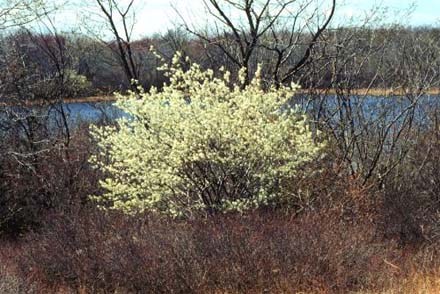
Another native worth considering in the landscape as an alternative to the ubiquitous pear is the green hawthorn (Crataegus viridis). Unlike the invasive pear, the hawthorn has four seasons of landscape ornamental interest from spring flowers, and summer foliage, to fall color and winter berries. The invasive Bradford pear hides its true destructive nature behind a fleeting spring display. As Vergil might have written: “Quidquid id est,  timeo Prunos et dona ferentis”
timeo Prunos et dona ferentis” 
Thursday, April 02, 2009
Annapolis Ordinance No. O-05-09: a Disservice to Invasive Species Issues
The capitol city of Maryland, Annapolis, is considering an ordinance “…to prohibit invasive plants on any lot or parcel of land within the City unless the plant is completed contained to control growth and prevent encroachment.”[1] But because this is not a bill to protect natural area ecosystem services but to enforce taste and tranquility on neighboring residents without adding to city expenses, the ordinance makes sweeping exceptions that include “… bona fide agricultural property, natural wooded areas, unimproved areas of more than three acres, public parks and recreational property being specifically maintained as natural areas, private open space areas covenanted with the City as recreational areas to be maintained in their natural state, and areas where vegetation is deemed necessary for soil stabilization and erosion control…” Quite effectively the city of Annapolis guts the reason to be concerned about invasive species – the protection of natural areas’ ecosystems and their services.
Hiding behind invasive species to promulgate a weed law will negatively impact public perception of valid invasive species programs. If Annapolis does not like some ornamental plants, then the city should say so. If Annapolis wants to help the ecosystem then prohibit the species on ALL the land not just the land of private citizens, and present a model law, public costs and all included.
Ordinance No. O-05-09 does a poor job at defining everything from an invasive plant to the concept of containment. This is a legislative attempt to solve a dispute between neighbors; it is not an effort to control and mitigate the damage to the environment that invasive species can cause.
· Annapolis MD's Ordinance No. O-05-09 does not mention the National Invasive Species Council Advisory Committee federal definition white paper that explores the definition of invasive species at length
· U. S. Executive Order 13112 – defines an invasive species as “an alien species whose introduction does or is likely to cause economic or environmental harm or harm to human health.”
· Ordinance No. O-05-09 makes no mention of the Maryland Invasive Species Council’s advisory list. The ordinance does however cite an educational list from the southeastern United States.
· Invasive species are harmful to natural area eco-systems that are exempt under Ordinance No. O-05-09. The proposed law exempts natural areas and parks, and landscapes most harmed by invasive species. The exemption makes little sense as many invasive plant species have traditional ornamental value providing at least a high level eco-system informing or cultural service.
· Ordinance No. O-05-09 does not define containment.
· Ordinance No. O-05-09 does not prohibit the planting or growth of invasive plants; it requires that such plants be contained by barriers or other similar means so as to keep the plants from encroaching upon abutting property, city easements, or public right-of-ways. However it does not require the City to remove invasive species from its public lands setting up the possible endless cycle of removal by private property owners, ad infinitum.
· Ordinance No. O-05-09 presents, as substantiating reasons, definitions of traditional landscape ground covers as reasons to ban traditional landscape groundcovers that have few, if any, natural predators, such as herbivores and diseases, to keep them in check. Many ornamental ground covers share some important characteristics that allow them to grow quickly in adverse, high human traffic situations. These include: (1) spreading aggressively by runners or rhizomes; (2) producing large numbers of seeds that survive to germinate; and (3) dispersing seeds away from the parent plant through various means such as wind, water, wildlife and people. This is a circular argument.
· The ordinance fails to address the natural area implications of invasive species impacts using language meant for “natural” undeveloped land.
[1] O-05-09; Invasive Plants: http://www.ci.annapolis.md.us/upload/images/government/council/Pending/O0509.pdf
Hiding behind invasive species to promulgate a weed law will negatively impact public perception of valid invasive species programs. If Annapolis does not like some ornamental plants, then the city should say so. If Annapolis wants to help the ecosystem then prohibit the species on ALL the land not just the land of private citizens, and present a model law, public costs and all included.
Ordinance No. O-05-09 does a poor job at defining everything from an invasive plant to the concept of containment. This is a legislative attempt to solve a dispute between neighbors; it is not an effort to control and mitigate the damage to the environment that invasive species can cause.
· Annapolis MD's Ordinance No. O-05-09 does not mention the National Invasive Species Council Advisory Committee federal definition white paper that explores the definition of invasive species at length
· U. S. Executive Order 13112 – defines an invasive species as “an alien species whose introduction does or is likely to cause economic or environmental harm or harm to human health.”
· Ordinance No. O-05-09 makes no mention of the Maryland Invasive Species Council’s advisory list. The ordinance does however cite an educational list from the southeastern United States.
· Invasive species are harmful to natural area eco-systems that are exempt under Ordinance No. O-05-09. The proposed law exempts natural areas and parks, and landscapes most harmed by invasive species. The exemption makes little sense as many invasive plant species have traditional ornamental value providing at least a high level eco-system informing or cultural service.
· Ordinance No. O-05-09 does not define containment.
· Ordinance No. O-05-09 does not prohibit the planting or growth of invasive plants; it requires that such plants be contained by barriers or other similar means so as to keep the plants from encroaching upon abutting property, city easements, or public right-of-ways. However it does not require the City to remove invasive species from its public lands setting up the possible endless cycle of removal by private property owners, ad infinitum.
· Ordinance No. O-05-09 presents, as substantiating reasons, definitions of traditional landscape ground covers as reasons to ban traditional landscape groundcovers that have few, if any, natural predators, such as herbivores and diseases, to keep them in check. Many ornamental ground covers share some important characteristics that allow them to grow quickly in adverse, high human traffic situations. These include: (1) spreading aggressively by runners or rhizomes; (2) producing large numbers of seeds that survive to germinate; and (3) dispersing seeds away from the parent plant through various means such as wind, water, wildlife and people. This is a circular argument.
· The ordinance fails to address the natural area implications of invasive species impacts using language meant for “natural” undeveloped land.
[1] O-05-09; Invasive Plants: http://www.ci.annapolis.md.us/upload/images/government/council/Pending/O0509.pdf
Sunday, March 29, 2009
Annapolis Maryland proposes to ban invasive species - plants
The City of Annapolis, Maryland has decided to enter the war on invasive species - plants only. Introduced by Alderman Paone, ORDINANCE NO. O-05-09 is offered for “…the purpose of prohibiting invasive plants on lots or parcels within the City unless completely contained to control growth and prevent encroachment.” Unfortunately for the conversation and dialogue among interested parties, the Council thus far has decided to overlook the United States federal advisory committee definition white paper as a source for its working concept of “invasive species”. Instead, quoting from the proposed legislation, “…Invasive plants, as defined in “Invasive Plants of the Eastern United States” by the U.S. Department of Agriculture and the University of Georgia, are not permitted on any lot or parcel of land within the City unless completely contained so as to control growth and prevent any encroachment upon or interference with neighboring properties, utilities, streets, sidewalks, or structures of any kind.”[1] Clarity in legislation and sources of definition for wicked messy problems are a wicked inconvenience for some.
Wicked problems by their nature become a definitional struggle among stakeholders and woe to the policy arbiter who ignores this part of the controversy. The United States government recognizing the myriad definitions and fragmentation of the discussion by producing a white paper intended to provide a non-regulatory policy interpretation of the term invasive species by identifying what is meant, and just as important, what is not meant by the term. Executive Order 13112 – defines an invasive species as “an alien species whose introduction does or is likely to cause economic or environmental harm or harm to human health.” In the Executive Summary of the National Invasive Species Management Plan (NISMP) the term invasive species is further clarified and defined as “a species that is non-native to the ecosystem under consideration and whose introduction causes or is likely to cause economic or environmental harm or harm to human health.” [2]
The city of Annapolis has selected a well know and respected source of invasive species information. Invasive.org is a joint project of some of the following organizations and agencies: The Bugwood Network, USDA Forest Service & USDA APHIS PPQ.. The University of Georgia - Warnell School of Forest Resources and College of Agricultural and Environmental Sciences - Dept. of Entomology. The proposed bill is based on the Center’s statement that at least in part is not referenced in the legislation: “While this is not an official list of "invasive" plants throughout the eastern United States, it includes Federal Noxious Weeds and those listed by State regulatory agencies, pest plant councils and other organizations. Some of the plants on this list are often found in ornamental plantings and landscapes. In fact, many non-native plants introduced for horticultural and agricultural use now pose a serious ecological threat in the absence of their natural predators and control agents. This publication will aid landowners, foresters, resource managers, and the general public in becoming familiar with invasive plants in their area to help protect our environment from the economic and ecological impacts of these biological pollutants.”[3] Maryland’s own MISC (Maryland Invasive Species Council) list could have been cited, but was not.
Invasive species issues are controversial and problematic. Dr. Robert Lackey proposes nine generalities, all of which may come into play with the proposal:[4]
(1) the policy and political dynamic is a zero-sum game;
(2) the distribution of benefits and costs is more important than the ratio of total benefits to total costs;
(3) the most politically viable policy choice spreads the benefits to a broad majority with the costs limited to a narrow minority of the population;
(4) potential losers are usually more assertive and vocal than potential winners and are, therefore, disproportionately important in decision making;
(5) many advocates will cloak their arguments as science to mask their personal policy preferences;
(6) even with complete and accurate scientific information, most policy issues remain divisive; (7) demonizing policy advocates supporting competing policy options is often more effective than presenting rigorous analytical arguments;
(8) if something can be measured accurately and with confidence, it is probably not particularly relevant in decision making;
(9) the meaning of words matters greatly and arguments over their precise meaning are often surrogates for debates over values.
Dr. Lacey continues: “Wicked, messy ecological policy problems share several qualities: (1) complexity
— innumerable options and trade-offs;
(2) polarization — clashes between competing
values;
(3) winners and losers — for each policy choice, some will clearly benefit, some
will be harmed, and the consequences for others is uncertain;
(4) delayed consequences
— no immediate "fix" and the benefits, if any, of painful concessions will often not be
evident for decades;
(5) decision distortion — advocates often appeal to strongly held
values and distort or hide the real policy choices and their consequences;
(6) national vs. regional conflict — national (or international) priorities often differ substantially from those at the local or regional level; and (7) ambiguous role for science — science is often not pivotal in evaluating policy options, but science often ends up serving inappropriately as a surrogate for debates over values and preferences.
List from Invasive Plants of the Eastern United States: Identification and Control
alligatorweed
Alternanthera philoxeroides (Mart.) Griseb.
waterhyacinth
Eichhornia crassipes (Mart.) Solms
hydrilla
Hydrilla verticillata (L. f.) Royle
parrot feather watermilfoil
Myriophyllum aquaticum (Vell.) Verdc.
Eurasian watermilfoil
Myriophyllum spicatum L.
waterlettuce
Pistia stratiotes L.
giant salvinia
Salvinia molesta D. S. Mitchell
water chestnut
Trapa natans L.
Japanese climbing fern
Lygodium japonicum (Thunb. ex Murr.) Sw.
old world climbing fern
Lygodium microphyllum (Cav.) R. Br.
garlic mustard
Alliaria petiolata (Bieb.) Cavara & Grande
plumeless thistle
Carduus acanthoides L.
musk thistle
Carduus nutans L.
winged plumeless thistle
Carduus tenuiflorus W. Curtis
spotted knapweed
Centaurea biebersteinii DC
Canada thistle
Cirsium arvense (L.) Scop.
bull thistle
Cirsium vulgare (Savi) Ten.
tropical spiderwort
Commelina benghalensis L.
cypress spurge
Euphorbia cyparissias L.
leafy spurge
Euphorbia esula L.
goatsrue
Galega officinalis L.
orange daylily
Hemerocallis fulva (L.) L.
giant hogweed
Heracleum mantegazzianum Sommier & Levier
shrubby lespedeza
Lespedeza bicolor Turcz.
Chinese lespedeza
Lespedeza cuneata (Dum.-Cours.) G. Don
purple loosestrife
Lythrum salicaria L.
marsh dewflower
Murdannia keisak (Hassk.) Hand.-Maz.
small broomrape
Orobanche minor Sm.
Japanese knotweed
Polygonum cuspidatum Sieb. & Zucc.
lesser Celandine
Ranunculus ficaria L.
wetland nightshade
Solanum tampicense Dunal
turkeyberry
Solanum torvum Swartz
tropical soda apple
Solanum viarum Dunal
Asiatic witchweed
Striga asiatica (L.) Kuntze
coltsfoot
Tussilago farfara L.
giant reed
Arundo donax L.
deeprooted sedge
Cyperus entrerianus Boeck.
cogongrass
Imperata cylindrica (L.) Beauv.
tall fescue
Lolium arundinaceum (Schreb.) S.J. Darbyshire
Nepalese browntop
Microstegium vimineum (Trin.) A. Camus
Chinese silvergrass
Miscanthus sinensis Anderss.
common reed
Phragmites australis (Cav.) Trin. ex Steud.
golden bamboo
Phyllostachys aurea Carr. ex A.& C. Rivière
itchgrass
Rottboellia cochinchinensis (Lour.) W.D. Clayton
Johnsongrass
Sorghum halepense (L.) Pers.
Japanese barberry
Berberis thunbergii DC.
butterflybush
Buddleja spp. L.
thorny olive
Elaeagnus pungens Thunb.
autumn olive
Elaeagnus umbellata Thunb.
winged burning bush
Euonymus alata (Thunb.) Sieb.
Japanese privet
Ligustrum japonicum Thunb.
glossy privet
Ligustrum lucidum Ait. f.
Chinese privet
Ligustrum sinense Lour.
European privet
Ligustrum vulgare L.
sweet breath of spring
Lonicera fragrantissima Lindl. & Paxton
Amur honeysuckle
Lonicera maackii (Rupr.) Herder
Morrow's honeysuckle
Lonicera morrowii Gray
Tatarian honeysuckle
Lonicera tatarica L.
sacred bamboo
Nandina domestica Thunb.
jetbead
Rhodotypos scandens (Thunb.) Makino
Macartney rose
Rosa bracteata J.C. Wendl.
multiflora rose
Rosa multiflora Thunb. ex Murr.
wine raspberry
Rubus phoenicolasius Maxim.
Japanese spiraea
Spiraea japonica L. f.
Norway maple
Acer platanoides L.
tree of heaven
Ailanthus altissima (P. Mill.) Swingle
mimosa
Albizia julibrissin Durazz.
paper mulberry
Broussonetia papyrifera (L.) L'Hér. ex Vent.
Russian olive
Elaeagnus angustifolia L.
melaleuca
Melaleuca quinquenervia (Cav.) Blake
chinaberrytree
Melia azedarach L.
white mulberry
Morus alba L.
princesstree
Paulownia tomentosa (Thunb.) Sieb. & Zucc. ex Steud.
Bradford pear
Pyrus calleryana 'Bradford'
sawtooth oak
Quercus acutissima Carruthers
Brazilian peppertree
Schinus terebinthifolius Raddi
tallow tree
Triadica sebifera (L.) Small
Siberian elm
Ulmus pumila L.
fiveleaf akebia
Akebia quinata (Houtt.) Dcne.
Amur peppervine
Ampelopsis brevipedunculata (Maxim.) Trautv.
oriental bittersweet
Celastrus orbiculata Thunb.
purple crownvetch
Coronilla varia L.
Japanese dodder
Cuscuta japonica Choisy
swallow-worts
Cynanchum spp. L.
water yam
Dioscorea alata L.
air yam
Dioscorea bulbifera L.
Chinese yam
Dioscorea oppositifolia L.
winter creeper
Euonymus fortunei (Turcz.) Hand.-Maz.
English ivy
Hedera helix L.
Japanese honeysuckle
Lonicera japonica Thunb.
skunk vine
Paederia foetida L.
mile-a-minute weed
Polygonum perfoliatum L.
kudzu
Pueraria montana (Lour.) Merr.
bigleaf periwinkle
Vinca major L.
common periwinkle
Vinca minor L.
Chinese wisteria
Wisteria sinensis (Sims) DC.
Japanese Wisteria
Wisteria floribunda (Willd.) DC..
[1] http://www.ci.annapolis.md.us/upload/images/government/council/Pending/O0509.pdf
[2] Invasive Species Definition Clarification and Guidance White Paper, Submitted by the Definitions Subcommittee of the Invasive Species Advisory Committee (ISAC), Approved by ISAC April 27, 2006; http://www.invasivespeciesinfo.gov/docs/council/isacdef.pdf
[3] Charles T. Bargeron, David J. Moorhead, G. Keith Douce, Richard C. Reardon and Arthur E. Miller The University of Georgia, USDA APHIS PPQ and USDA Forest Service Forest Health Technology Enterprise Team. FHTET-2003-08; http://www.invasive.org/eastern/
[4] Lackey, Robert T. 2006. Axioms of ecological policy. Fisheries. 31(6): 286-290.
Wicked problems by their nature become a definitional struggle among stakeholders and woe to the policy arbiter who ignores this part of the controversy. The United States government recognizing the myriad definitions and fragmentation of the discussion by producing a white paper intended to provide a non-regulatory policy interpretation of the term invasive species by identifying what is meant, and just as important, what is not meant by the term. Executive Order 13112 – defines an invasive species as “an alien species whose introduction does or is likely to cause economic or environmental harm or harm to human health.” In the Executive Summary of the National Invasive Species Management Plan (NISMP) the term invasive species is further clarified and defined as “a species that is non-native to the ecosystem under consideration and whose introduction causes or is likely to cause economic or environmental harm or harm to human health.” [2]
The city of Annapolis has selected a well know and respected source of invasive species information. Invasive.org is a joint project of some of the following organizations and agencies: The Bugwood Network, USDA Forest Service & USDA APHIS PPQ.. The University of Georgia - Warnell School of Forest Resources and College of Agricultural and Environmental Sciences - Dept. of Entomology. The proposed bill is based on the Center’s statement that at least in part is not referenced in the legislation: “While this is not an official list of "invasive" plants throughout the eastern United States, it includes Federal Noxious Weeds and those listed by State regulatory agencies, pest plant councils and other organizations. Some of the plants on this list are often found in ornamental plantings and landscapes. In fact, many non-native plants introduced for horticultural and agricultural use now pose a serious ecological threat in the absence of their natural predators and control agents. This publication will aid landowners, foresters, resource managers, and the general public in becoming familiar with invasive plants in their area to help protect our environment from the economic and ecological impacts of these biological pollutants.”[3] Maryland’s own MISC (Maryland Invasive Species Council) list could have been cited, but was not.
Invasive species issues are controversial and problematic. Dr. Robert Lackey proposes nine generalities, all of which may come into play with the proposal:[4]
(1) the policy and political dynamic is a zero-sum game;
(2) the distribution of benefits and costs is more important than the ratio of total benefits to total costs;
(3) the most politically viable policy choice spreads the benefits to a broad majority with the costs limited to a narrow minority of the population;
(4) potential losers are usually more assertive and vocal than potential winners and are, therefore, disproportionately important in decision making;
(5) many advocates will cloak their arguments as science to mask their personal policy preferences;
(6) even with complete and accurate scientific information, most policy issues remain divisive; (7) demonizing policy advocates supporting competing policy options is often more effective than presenting rigorous analytical arguments;
(8) if something can be measured accurately and with confidence, it is probably not particularly relevant in decision making;
(9) the meaning of words matters greatly and arguments over their precise meaning are often surrogates for debates over values.
Dr. Lacey continues: “Wicked, messy ecological policy problems share several qualities: (1) complexity
— innumerable options and trade-offs;
(2) polarization — clashes between competing
values;
(3) winners and losers — for each policy choice, some will clearly benefit, some
will be harmed, and the consequences for others is uncertain;
(4) delayed consequences
— no immediate "fix" and the benefits, if any, of painful concessions will often not be
evident for decades;
(5) decision distortion — advocates often appeal to strongly held
values and distort or hide the real policy choices and their consequences;
(6) national vs. regional conflict — national (or international) priorities often differ substantially from those at the local or regional level; and (7) ambiguous role for science — science is often not pivotal in evaluating policy options, but science often ends up serving inappropriately as a surrogate for debates over values and preferences.
List from Invasive Plants of the Eastern United States: Identification and Control
alligatorweed
Alternanthera philoxeroides (Mart.) Griseb.
waterhyacinth
Eichhornia crassipes (Mart.) Solms
hydrilla
Hydrilla verticillata (L. f.) Royle
parrot feather watermilfoil
Myriophyllum aquaticum (Vell.) Verdc.
Eurasian watermilfoil
Myriophyllum spicatum L.
waterlettuce
Pistia stratiotes L.
giant salvinia
Salvinia molesta D. S. Mitchell
water chestnut
Trapa natans L.
Japanese climbing fern
Lygodium japonicum (Thunb. ex Murr.) Sw.
old world climbing fern
Lygodium microphyllum (Cav.) R. Br.
garlic mustard
Alliaria petiolata (Bieb.) Cavara & Grande
plumeless thistle
Carduus acanthoides L.
musk thistle
Carduus nutans L.
winged plumeless thistle
Carduus tenuiflorus W. Curtis
spotted knapweed
Centaurea biebersteinii DC
Canada thistle
Cirsium arvense (L.) Scop.
bull thistle
Cirsium vulgare (Savi) Ten.
tropical spiderwort
Commelina benghalensis L.
cypress spurge
Euphorbia cyparissias L.
leafy spurge
Euphorbia esula L.
goatsrue
Galega officinalis L.
orange daylily
Hemerocallis fulva (L.) L.
giant hogweed
Heracleum mantegazzianum Sommier & Levier
shrubby lespedeza
Lespedeza bicolor Turcz.
Chinese lespedeza
Lespedeza cuneata (Dum.-Cours.) G. Don
purple loosestrife
Lythrum salicaria L.
marsh dewflower
Murdannia keisak (Hassk.) Hand.-Maz.
small broomrape
Orobanche minor Sm.
Japanese knotweed
Polygonum cuspidatum Sieb. & Zucc.
lesser Celandine
Ranunculus ficaria L.
wetland nightshade
Solanum tampicense Dunal
turkeyberry
Solanum torvum Swartz
tropical soda apple
Solanum viarum Dunal
Asiatic witchweed
Striga asiatica (L.) Kuntze
coltsfoot
Tussilago farfara L.
giant reed
Arundo donax L.
deeprooted sedge
Cyperus entrerianus Boeck.
cogongrass
Imperata cylindrica (L.) Beauv.
tall fescue
Lolium arundinaceum (Schreb.) S.J. Darbyshire
Nepalese browntop
Microstegium vimineum (Trin.) A. Camus
Chinese silvergrass
Miscanthus sinensis Anderss.
common reed
Phragmites australis (Cav.) Trin. ex Steud.
golden bamboo
Phyllostachys aurea Carr. ex A.& C. Rivière
itchgrass
Rottboellia cochinchinensis (Lour.) W.D. Clayton
Johnsongrass
Sorghum halepense (L.) Pers.
Japanese barberry
Berberis thunbergii DC.
butterflybush
Buddleja spp. L.
thorny olive
Elaeagnus pungens Thunb.
autumn olive
Elaeagnus umbellata Thunb.
winged burning bush
Euonymus alata (Thunb.) Sieb.
Japanese privet
Ligustrum japonicum Thunb.
glossy privet
Ligustrum lucidum Ait. f.
Chinese privet
Ligustrum sinense Lour.
European privet
Ligustrum vulgare L.
sweet breath of spring
Lonicera fragrantissima Lindl. & Paxton
Amur honeysuckle
Lonicera maackii (Rupr.) Herder
Morrow's honeysuckle
Lonicera morrowii Gray
Tatarian honeysuckle
Lonicera tatarica L.
sacred bamboo
Nandina domestica Thunb.
jetbead
Rhodotypos scandens (Thunb.) Makino
Macartney rose
Rosa bracteata J.C. Wendl.
multiflora rose
Rosa multiflora Thunb. ex Murr.
wine raspberry
Rubus phoenicolasius Maxim.
Japanese spiraea
Spiraea japonica L. f.
Norway maple
Acer platanoides L.
tree of heaven
Ailanthus altissima (P. Mill.) Swingle
mimosa
Albizia julibrissin Durazz.
paper mulberry
Broussonetia papyrifera (L.) L'Hér. ex Vent.
Russian olive
Elaeagnus angustifolia L.
melaleuca
Melaleuca quinquenervia (Cav.) Blake
chinaberrytree
Melia azedarach L.
white mulberry
Morus alba L.
princesstree
Paulownia tomentosa (Thunb.) Sieb. & Zucc. ex Steud.
Bradford pear
Pyrus calleryana 'Bradford'
sawtooth oak
Quercus acutissima Carruthers
Brazilian peppertree
Schinus terebinthifolius Raddi
tallow tree
Triadica sebifera (L.) Small
Siberian elm
Ulmus pumila L.
fiveleaf akebia
Akebia quinata (Houtt.) Dcne.
Amur peppervine
Ampelopsis brevipedunculata (Maxim.) Trautv.
oriental bittersweet
Celastrus orbiculata Thunb.
purple crownvetch
Coronilla varia L.
Japanese dodder
Cuscuta japonica Choisy
swallow-worts
Cynanchum spp. L.
water yam
Dioscorea alata L.
air yam
Dioscorea bulbifera L.
Chinese yam
Dioscorea oppositifolia L.
winter creeper
Euonymus fortunei (Turcz.) Hand.-Maz.
English ivy
Hedera helix L.
Japanese honeysuckle
Lonicera japonica Thunb.
skunk vine
Paederia foetida L.
mile-a-minute weed
Polygonum perfoliatum L.
kudzu
Pueraria montana (Lour.) Merr.
bigleaf periwinkle
Vinca major L.
common periwinkle
Vinca minor L.
Chinese wisteria
Wisteria sinensis (Sims) DC.
Japanese Wisteria
Wisteria floribunda (Willd.) DC..
[1] http://www.ci.annapolis.md.us/upload/images/government/council/Pending/O0509.pdf
[2] Invasive Species Definition Clarification and Guidance White Paper, Submitted by the Definitions Subcommittee of the Invasive Species Advisory Committee (ISAC), Approved by ISAC April 27, 2006; http://www.invasivespeciesinfo.gov/docs/council/isacdef.pdf
[3] Charles T. Bargeron, David J. Moorhead, G. Keith Douce, Richard C. Reardon and Arthur E. Miller The University of Georgia, USDA APHIS PPQ and USDA Forest Service Forest Health Technology Enterprise Team. FHTET-2003-08; http://www.invasive.org/eastern/
[4] Lackey, Robert T. 2006. Axioms of ecological policy. Fisheries. 31(6): 286-290.
Subscribe to:
Posts (Atom)