Showing posts with label pratical jokes; soil; invasive. Show all posts

Sunday, December 09, 2012

Mt Rainier, Maryland, Faces Wickedly Inconvenient Invasive Bamboo Problem

Yellow groove bamboo, Phyllostachys aureosulcata invading a natural area
image by Caryn Rickel, Institute of Invasive Bamboo Research, Bugwood.org


               For each community there comes a time when the invasive impact of a charismatic mega species finally causes an epiphany and an interest in one century of concern takes hold. Most of us are comfortably landscape illiterate and cannot be bothered with an invasive species especially if it is a plant, because most of us identify a plant as a tree or shrub, flower or grass and, then, quickly move on to our morning coffee.  We no longer know the common names, and sure enough cannot deal with the impossible to pronounce alien-exotic sounding names such as Phyllostachysaureoculcata McClure (1945) at any time of the day.

               Mount Rainier, a small town in Prince George's County, Maryland, my county, has found itself under attack from past landscape practices of its own doing, and now wants action and proposes a ban on all invasive plants. The immediacy of the idea obscures the question as to what exactly is an invasive plants, but oppressed homeowners and beleaguered politicians seldom let actual context interfere with well-meaning intentions. The press, of course, does not have the time or resources to actually talk to people who know a little or much about invasive species, but rather focus on factoids that sell news by fanning the flames of simplistic thinking.

               Invasive species issues are seldom, if ever, linear. They are not solved by direct line thinking. Simple solutions like a city ban will not solve the existing problem. This is the wicked inconvenience of invasives. Simple solution will inevitably cause unintended consequences and more problems. Invasive species impacts are wicked problems because they involve many vested interests, ill-defined definitions, limited resources  and short, near term frame of mind goals (interest is lost easily). For example, a land manager invests the money and time to remove a weed from a play ground but does not have a long term plan for what comes next, resulting in a new species quietly establishing because there was no EDRR plan put in place as part of the original plant removal. 

               Mount Rainier has a bamboo problem. Which bamboo exactly is causing the problem? This is a trick question because almost assuredly they have no idea that there are 26 species in the genus. Most likely, they are dealing with one of two possibilities, but what reference are they using to establish that identification. More worrisome is the idea that a ban will solve the problem. A ban will solve tomorrow's neighbors' incursion but today's property owners will still be left with the financial burden of mitigating the damage to get back full use of their land. The real issue is how to make existing property owners whole. Who is responsible for the loss of the use of my land when a neighbor's invasive species jumps the fence?

               There is little doubt that some species of invasives especially certain bamboos can rip part patios, chew through foundations, uproot asphalt, grow through concrete, and otherwise make practicable use of a property impossible for any reason. And these few specific bamboos are not alone in the invasive category  - just ask the Confederacy about kudzu, fire ants and pythons to name a few. It is good to remember that in spite of these facts, bamboo, as of now, mostly impacts managed gardens, properties, and landscapes. Because the term of art invasive species comes out of ecological and natural land management investigations, the labeling of bamboo as 'invasive' causes definitional problems.[1] It would be better, perhaps,  if historically we had not separated the idea of weeds and invasive plants, but we have. The so-called 'running' bamboos are destructive, aggressively harmful,'noxious' landscape weeds that do not fit well into classic invasive species categories especially those that require harm to natural areas and that require seeding pressure (something these bamboos do not do - yet). 

               For over thirty years a generation of dedicated volunteers and professionals has been trying to get the rest of us to notice that we have a problem, but until the problem costs us personally, we do nothing preferring to be ecological ostriches.

               Mount Rainier needs a plan before a law. It needs to put a cutting edge comprehensive program together that involves sustainable landscaping practices (SITES). The town needs an outreach program to its citizens on what the problem is and what they can do about it personally.  The town needs to support through information web sites best management practices for new installation and old landscape maintenance strategies (integrated pest management practices: IPM). The town should be putting together an early detection and rapid response (EDRR) program do ensure they never have this kind of problem again. And finally, Mount Rainier should be advocating for a county-wide policy, for every community is part of an ecosystem, and invasive species issues must be managed holistically at the ecosystem level.


[1] As per Executive Order 13112 an "invasive species" is defined as a species that is:

1) non-native (or alien) to the ecosystem under consideration and

2) whose introduction causes or is likely to cause economic or environmental harm or harm to human health.

Monday, April 23, 2012

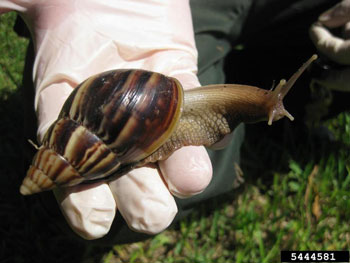
Have you met the Giant African Land Snail, an Invasive Species of the first order?


LISSACHATINA FULICA GIANT AFRICAN SNAIL, GIANT AFRICAN LAND SNAIL Texas Invasives.org http://www.texasinvasives.org/animal_database/detail.php?symbol=24 


              GAS (Giant African Snail, sometimes Giant African Land Snail) , (Lissachatina fulica, formerly Achatina fulica), is one of the most damaging snails in the world because it is known to consume at least 500 different plants including vegetables, fruits, and ornamental crops such as including beans, peas, cucumbers, carrots, onions, potatoes, spinach, broccoli, cabbage, and melons The invasive non indigenous (not native) snail is also the carrier of the rat lungworm, Angiostrongylus cantonensis.  As a invasive species goes this one rises to the level of charismatic in its own special way. The giant African snail, L. fulica, according to the CABI fact sheet, easily becomes attached to any means of transport or machinery at any developmental stage; is able to go into a state of aestivation in cooler conditions; and  is readily transportable over distances.  

            Florida is by virtue of its hospitable climates is under attack from a wide range of invasive species of which GAS is but one. The Florida Department of Agriculture and Consumer Services identified GAS in Miami-Dade County on Sep 15, 2011. Able to consume at least 500 different types of plants, the invasive snail "can cause structural damage to plaster and stucco, and can carry a parasitic nematode that can lead to meningitis in humans. Anyone who believes they may have seen a Giant African land snail or signs of its presence should call FDACS toll-free at 888-397-1517 to make arrangements to have the snail collected." (USDA NAL Invasive Species Information Center)

            The invasive GAS is a federally regulated species: Snails in the genus Achatina (e.g., Achatina fulica, the Giant African Snail), are specifically prohibited for both interstate movement and importation into the U.S. This snail species group is not only strictly prohibited from entering the U.S. but is safeguarded when discovered. (USDA, APHIS - Regulated Organism and Soil Permits: Snails and Slugs)

            USDA APHIS (Animal Plant Health Inspection Service) thinks that the giant African land snail, is originally from East Africa. The invasive snail has become established throughout the Indo-Pacific Basin, including the Hawaiian Islands according to APHIS. This mollusk has also been introduced to the Caribbean islands of Martinique and Guadeloupe. Recently, the snails were detected on Saint Lucia and Barbados. (USDA APHIS GAS Factsheet)

            USDA recently discovered and confiscated illegal invasive giant African land snails from commercial pet stores, schools and one private breeder in Wisconsin, Illinois, and Ohio. Additional finds of the snails have been discovered in Michigan. Amazingly, these snails are being used increasingly for science lessons in schools by teachers who are unaware of the risks associated with the snails and the illegality of possessing them.

The nematode (roundworm) Angiostrongylus cantonensis, the rat lungworm, is the most common cause of human eosinophilic meningitis.  In addition, Angiostrongylus (Parastrongylus) costaricensis is the causal agent of abdominal, or intestinal, angiostrongyliasis. http://www.dpd.cdc.gov/dpdx/html/angiostrongyliasis.htm   


                Giant African snails as mentioned above are carriers of the rat parasite, Angiostrongylus cantonensis. This parasite can be contracted by ingesting improperly cooked snail meat or by handling live snails and transferring snail mucus to the human mucus membranes such as those in the eyes, nose, and mouth. (Massachusetts Introduced Pests Outreach Project)

               If you have a Giant African Land Snail, PLEASE DO NOT RELEASE IT OUTSIDE OR GIVE IT AWAY.


 FOR INFORMATION AND ACTION
DA-2012-12 April 13, 2012

TO: STATE AND TERRITORY AGRICULTURAL REGULATORY OFFICIALS
The Animal and Plant Health Inspection Service (APHIS) is issuing a Federal Order, effective immediately, which establishes regulated areas in Miami-Dade County in Florida for the giant African snail (GAS).

On September 9, 2011, APHIS confirmed the detection of GAS, Lissachatina fulica, in a residential area of Miami, Florida. Since the initial detection, APHIS has actively worked with the Florida Department of Agriculture and Consumer Services to conduct survey, regulatory, control, and outreach activities. While residential areas have been affected, to date, extensive surveys of nurseries and agricultural productions facilities within the infested areas have been negative for GAS.
The attached Federal Order outlines the safeguarding measures required for the interstate movement of regulated articles from the areas regulated for GAS. The requirements in the State’s interior quarantine for GAS are parallel to this Federal Order.

GAS is one of the most damaging snails in the world because it is known to consume at least 500 different plants including vegetables, fruits, and ornamental crops.

For further information, you may contact Robert Balaam, Eastern Regional Program Manager, at (305) 278- 4872, or Andrea Simao, National Program Manager, at (301) 851-2067.
/s/ Osama El-Lissy for
Rebecca A. Bech
Deputy Administrator
Plant Protection and Quarantine
Attachment (1)
-Federal Order

Monday, April 02, 2012

USDA Urges Americans to Prevent Invasive Pests, Protect American Agriculture


News Release

http://www.usda.gov/wps/portal/usda/usdahome?contentid=2012/04/0112.xml&contentidonly=true

 
Release No. 0112.12
Contact:
Greg Rosenthal (301) 851-4054
Suzanne Bond (301) 851-4070

 USDA Urges Americans to Prevent Invasive Pests, Protect American Agriculture
 
WASHINGTON, April 2, 2012—The U.S. Department of Agriculture's (USDA) Animal and Plant Health Inspection Service (APHIS) today announced that it is dedicating the month of April to sharing information about the threat that invasive plant pests, diseases and harmful weeds pose to America's fruits, vegetables, trees, and other plants—and how the public can help prevent their spread. APHIS works each day to promote U.S. agricultural health and safeguard the nation's agriculture, fishing and forestry industries.
"Invasive pests hit close to home and threaten the things we value," said Rebecca A. Blue, Deputy Under Secretary for USDA's Marketing and Regulatory Programs. "We need the public's help because these hungry pests can have a huge impact on the items we use in everyday life, from the fabric in our clothing, the food on our table, the lumber used to build our home and the flowers in our garden. During one of the most successful periods in history for U.S. agriculture, it is important that we step-up our efforts to educate Americans about USDA's good work to protect our nation's food, fiber, feed and fuel from invasive pests."
Invasive pests are non-native species that feed on America's agricultural crops, trees and other plants. These "hungry pests" have cost the United States billions of dollars and wreak havoc on the environment. USDA and U.S. Department of Homeland Security's Customs and Border Protection-working closely with state agriculture departments and industry-are dedicated to preventing the introduction and spread of invasive pests. The goal is to safeguard agriculture and natural resources from the entry, establishment and spread of animal and plant pests and noxious weeds.
But federal and state agencies can't do it alone. It requires everyone's help to stop the unintended introduction and spread of invasive pests. The number-one action someone can take is to leave hungry pests behind. USDA urges the public to visit www.HungryPests.com to learn more about invasive pests and what they can do to protect American agricultural resources by preventing the spread of these threats. Here are a few actions that people can take today:
  • Buy Local, Burn Local. Invasive pests and larvae can hide and ride long distances in firewood. Don't give them a free ride to start a new infestation-buy firewood where you burn it.
  • Plant Carefully. Buy your plants from a reputable source and avoid using invasive plant species at all costs.
  • Do Not Bring or Mail fresh fruits, vegetables, or plants into your state or another state unless agricultural inspectors have cleared them beforehand.
  • Cooperate with any agricultural quarantine restrictions and allow authorized agricultural workers access to your property for pest or disease surveys.
  • Keep It Clean. Wash outdoor gear and tires between fishing, hunting or camping trips. Clean lawn furniture and other outdoor items when moving from one home to another.
  • Learn To Identify. If you see signs of an invasive pest or disease, write down or take a picture of what you see, and then report it at www.HungryPests.com.
  • Speak Up. Declare all agricultural items to customs officials when returning from international travel. Call USDA to find out what's allowed:
    (301) 851-2046 for questions about plants
    (301) 851-3300 for questions about animals
At www.HungryPests.com, a website available in both English and Spanish, visitors can access the interactive Pest Tracker to see what pests are threatening in a selected state, and to learn how to report suspected invasive pests. The public can also engage on the invasive pests issue via Facebook and Twitter. HungryPests.com is optimized for mobile devices. Public service announcements in both English and Spanish will air on television and radio throughout April and at peak times for domestic travel this summer. APHIS has also been actively collaborating with a number of state partners who will conduct targeted stakeholder engagement on invasive pest issues with state-specific outreach materials.
Added Blue: "The USDA and its partners are fighting invasive pests on three fronts: abroad, at the border, and across the homeland. We're also developing new tools, improving our systems, and working hard to educate the public on how they can join the fight and help stop the spread of invasive pests."
There has been success in the fight against invasive pests. The Asian longhorned beetle, detected in Illinois in 1998, was declared eradicated from Illinois in 2008 with the help of local, state and federal partners and Illinois residents. The beetle was also declared eradicated from Hudson County, NJ; and Islip, NY. Extensive efforts by USDA and its partners in California reduced European grapevine moth populations in 2011 by 99.9 percent. That pest was first detected in California in 2009.
With Agriculture Secretary Vilsack's leadership, APHIS works tirelessly to create and sustain opportunities for America's farmers, ranchers and producers. Each day, APHIS promotes U.S. agricultural health, regulates genetically engineered organisms, administers the Animal Welfare Act, and carries out wildlife damage management activities, all to safeguard the nation's agriculture, fishing and forestry industries. In the event that a pest or disease of concern is detected, APHIS implements emergency protocols and partners with affected states and other countries to quickly manage or eradicate the outbreak. To promote the health of U.S. agriculture in the international trade arena, APHIS develops and advances science-based standards with trading partners to ensure America's agricultural exports, valued at more than $137 billion annually, are protected from unjustified restrictions.
#
USDA is an equal opportunity provider and employer. To file a complaint of discrimination, write: USDA, Office of the Assistant Secretary for Civil Rights, Office of Adjudication, 1400 Independence Ave., SW, Washington, DC 20250-9410 or call (866) 632-9992 (Toll-free Customer Service), (800) 877-8339 (Local or Federal relay), (866) 377-8642 (Relay voice users).

Friday, July 06, 2007

Invasive species levity, I hope, I think, maybe

I spend much of my time thinking about invasive species. So much time that I regularly begin to assume that everyone is as aware of the challenge of invasive species as I am, or that everyone is at least reading from the same page. In other words, I have lost the initial shock of awareness of a problem which I cannot begin to understand and the ramifications of which send me into reactionary mode. With plants, this amounts to the “don’t tell me what to grow, sell, buy, or plant” position. I long since have overcome this stance, and so it is with a strange sense of intellectual pleasure that I tripped over…drum roll please….INVASIVE SOILS…..

From a posting entitled. “Down and Dirty With Invasive Non-Native Soil”, I read with a certain amount of incredulity: “Using tweezers his group identifies and separates soil by type. Non-native dirt is then transported out of the park to holding areas.” One problem with the Internet is an inherent problem of certifying the veracity of a posting. A re-reading produced a telling quote or a significant typographical error: “We're attempting to restore the creek bed to its state on August 24th, 1843, at 3PM. After exhaustive research using Google, aspects of the science of phrenology, and an inventory of shovel blades from across the north state, we've determined that date represents the optimal health of the soil" stated Frolinger.”

Without further commentary on the potential for a great practical joke with shades of resistance to concepts offered within the invasive species movement. I notice an underlying truth: That the life within the soil is vital to the life a-top the soil. And, because the life within is mostly microscopic, it is mostly over-looked. Some research may find that alien, exotic plant species are changing the biota matrix within natural areas, with the result that native north American plants no longer have their historic soil partners, and can no longer compete with new comers, the ever-ready-to-take-advantage invasive species.

Remembering that some stakeholders in the invasive species question seek to limit the introduction of invasive species to natural areas in the hope that we can sustain functioning eco-systems, we must at least consider basic gardening tasks, which include amending the soils with changes as basic as pH change, and perhaps, the reintroduction of mychorriza . Years of liming, for example, have radically altered farm land once forested. Abandoned now, new owners struggle to encourage reforesting may be facing eastern natives inclination for a lower pH that is no longer found.

Let me close with a nudge, reminding readers to be wary when reading facts unverified. Just because you read it, does not mean it is fact. I try to be philosophical in my posting, which is another way of saying, opinionated, and do not pretend to be a primary source of information, but raher opinion, but, also try to be sure of the origins of my factoids. I am constantly aware of incorrect data in my searches on the web, to wit: a posting on this site, Tuesday, October 10, 2006, “Fall flowers and garden myths; ragweed & goldenrod